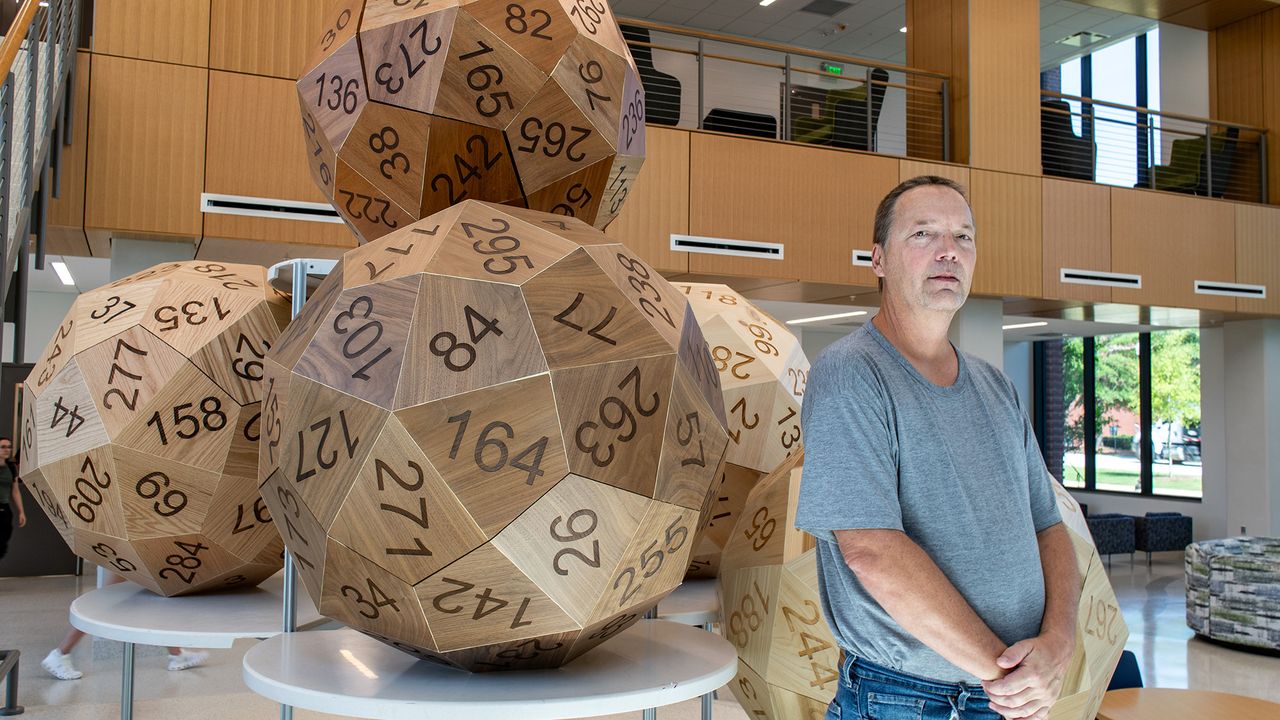
A team of mathematicians, led by Eric Harshbarger and Robert Ford, has created a set of five 60-sided dice designed to ensure a perfectly fair turn order for any number of players. The project, sparked by a question from board game designer James Ernest around 2010, took 15 years to complete.
Ernest posed the challenge at a gaming convention: could a set of dice be designed so that each player, regardless of the group size, would have an equal chance of going first? Harshbarger, a mathematician at Auburn University in Alabama, initially didn’t have an answer but the question persisted. He and collaborators worked to solve what became known as the “go first dice” problem.
The solution is a set of five 60-sided dice (hexecontahedrons) engraved with numbers 1 through 300, with no repeats. “The easy thing is to avoid ties; you just put different numbers on all the dice,” Harshbarger told Live Science. “The problem comes in how you distribute those different numbers across the dice so that the probability is equal not only for the whole set but for any subset.” The dice must maintain fairness regardless of how many players participate.
Harshbarger and Robert Ford, a mathematician at Dalton State College, initially solved the problem for three players using standard six-sided dice. They later expanded the solution to four players with 12-sided dice, which Harshbarger presented at math conferences in 2012, garnering media attention and requests for handmade sets. Five giant, wooden replicas of the 60-sided dice are now on permanent display in Auburn University’s new mathematics building.
Read the original coverage
💬 Comments
📜 Comment Policy