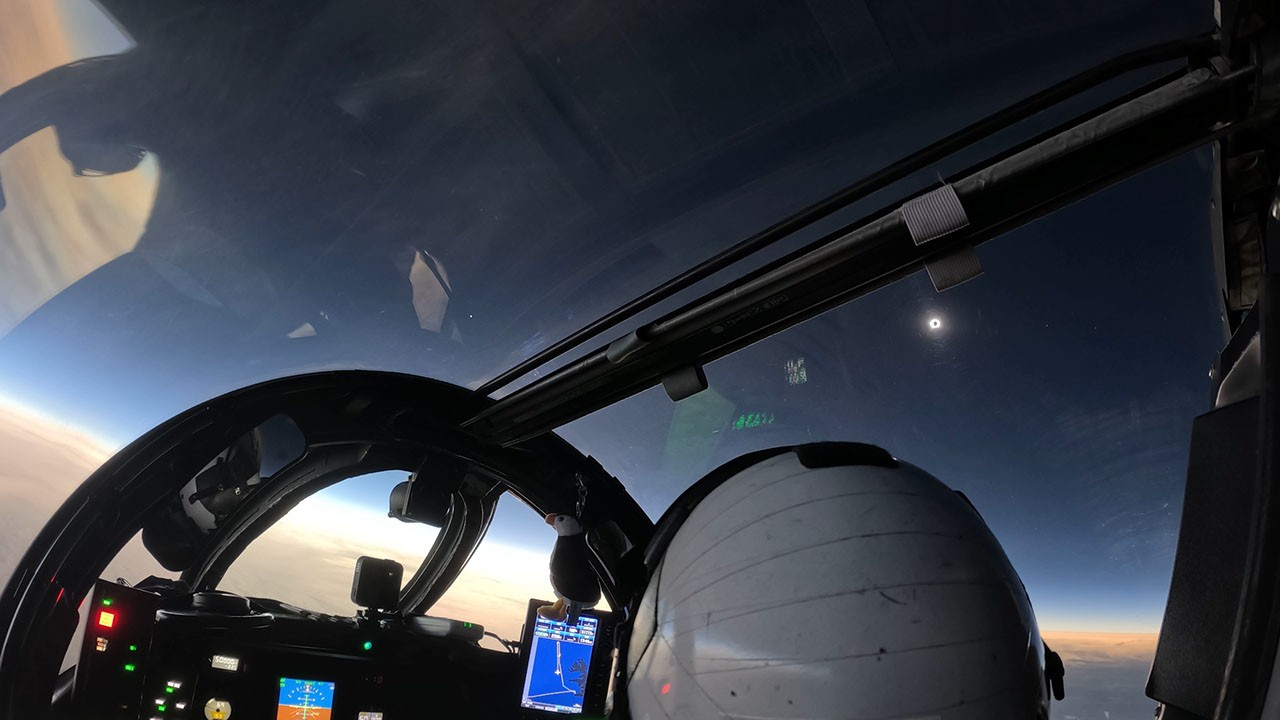
NASA’s WB-57F research aircraft flew off the coast of Iceland on August 12 to observe a total solar eclipse. The flight, piloted at 50,000 feet, followed the path of totality to maximize time within the Moon’s shadow. The purpose of the mission was to record eclipse data from above atmospheric interference.
A suite of high-resolution cameras on board the aircraft captured the eclipse. A view from an inflight video shows the solar corona emerging at the beginning of totality, with the sky darkened by the Moon’s shadow. Venus is visible to the left of center in the video frame, while Jupiter and Mercury are just visible to the right of the eclipsed Sun. Brightness remains along the distant horizon, beyond the reach of the Moon’s shadow.
NASA also announced that its Astronomy Picture of the Day (APOD) main site is moving from apod.nasa.gov to science.nasa.gov/apod. Tomorrow’s featured picture will focus on enhancing Pluto.
Read the original coverage
💬 Comments
📜 Comment Policy