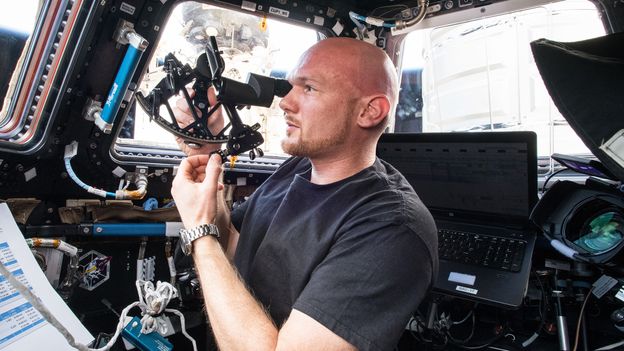
NASA is revisiting a 300-year-old navigation tool, the sextant, as a backup system for astronauts on deep space missions. The tool, traditionally used by seafarers, could prove crucial if electronic navigation systems fail during long-duration flights to destinations like Mars.
Greg Holt, the navigation system manager for the Orion Spacecraft and its Artemis missions to the Moon, explains that reliance on Earth-based navigation technology, such as satellites, decreases the further astronauts travel from Earth. This necessitates a return to “classical navigation techniques” developed in the 16th, 17th, and 18th centuries, where star sightings were used to determine location and orientation. Holt emphasizes that these skills are vital references when far from Earth and could save lives if communication is lost.
In 2018, astronauts Serena Auñón-Chancellor and Alexander Gerst aboard the International Space Station (ISS) tested a handheld sextant, taking measurements with the naked eye. The goal was to assess its viability as an emergency backup for navigating back from the Moon in the event of communication failure. As Holt stated, losing communication also means losing radio navigation links, leaving astronauts to rely on their own skills.
NASA initially adapted these ancient star-sighting methods for space flight in the 1960s. Neil Armstrong, the first man on the Moon, expressed concern about the accuracy of navigation and whether astronauts could navigate independently using celestial navigation if communication with Earth was lost.
Read the original coverage
💬 Comments
📜 Comment Policy