The Linux kernel’s Unsorted Block Images (UBI) layer has been updated in version 7.3 to support per-device wear-leveling thresholds for NAND flash memory. Previously, the wear-leveling threshold was a fixed, system-wide constant.
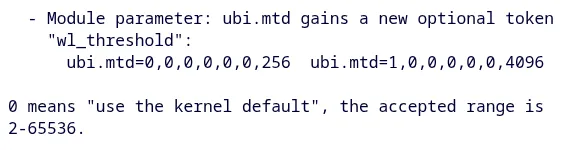
Ran Hongyun of Huawei developed the new functionality, addressing a long-standing limitation. The update allows systems with multiple NAND flash devices, each with potentially different erase lifetimes, to specify a unique wear-leveling threshold for each device. This is achieved through a new “wl_threshold” option for the ubi.mtd module parameter, configurable at boot time.
The “wl_threshold” option enables administrators to set a specific wear-leveling threshold for each NAND flash. Setting the value to zero reverts to the previous system-wide, compile-time constant. The code was merged into the Linux kernel on Friday.
Read the original coverage
💬 Comments
📜 Comment Policy