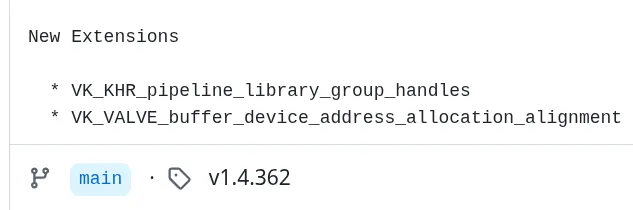
Vulkan 1.4.362, the newest specification update, has been released, featuring two new API extensions developed by Valve’s Linux graphics team. These extensions aim to improve compatibility with DirectX Ray-Tracing 1.1 and enhance Direct3D 12 layering with tools like Valve’s VKD3D-Proton.
The first new extension, VK_KHR_pipeline_library_group_handles, allows for querying group handles directly from pipeline libraries. This extension was a collaborative effort between Hans-Kristian Arntzen of Valve, along with engineers from AMD, Igalia, Intel, and NVIDIA. It directly improves compatibility with the DXR 1.1 (DirectX Ray-Tracing Tier 1.1) specification.
The second extension, VK_VALVE_buffer_device_address_allocation_alignment, was developed by Hans-Kristian Arntzen and Connor Abbott of Valve’s Linux graphics team. This extension allows applications to specify the alignment of any buffer device address allocation. According to the specification, this is intended to address issues arising when layering other APIs, such as Direct3D 12, where applications may rely on specific buffer address alignments. The spec elaborates: “This extension allows applications to specify the alignment of any buffer device address allocation, beyond the current specification requirements which only requires that the memory has enough alignment to satisfy any alignment request the implementation may require on its own. When layering some other APIs, e.g. D3D12, applications are sometimes able to rely on the allocated buffer device address being aligned to a potentially larger alignment than what the implementation would normally allocate for. Some applications rely on this implementation detail and will behave in unexpected ways if tighter alignments are used.”
Read the original coverage
💬 Comments
📜 Comment Policy