Supreme Court Blocks Missouri’s Republican-Drawn Congressional Map for Third Time
AI-synthesized · Bias removed · Facts only
3 sources: 2 left · 1 center · 0 right
Facts are sacred. Opinion is labelled.
Image: Guardian Us
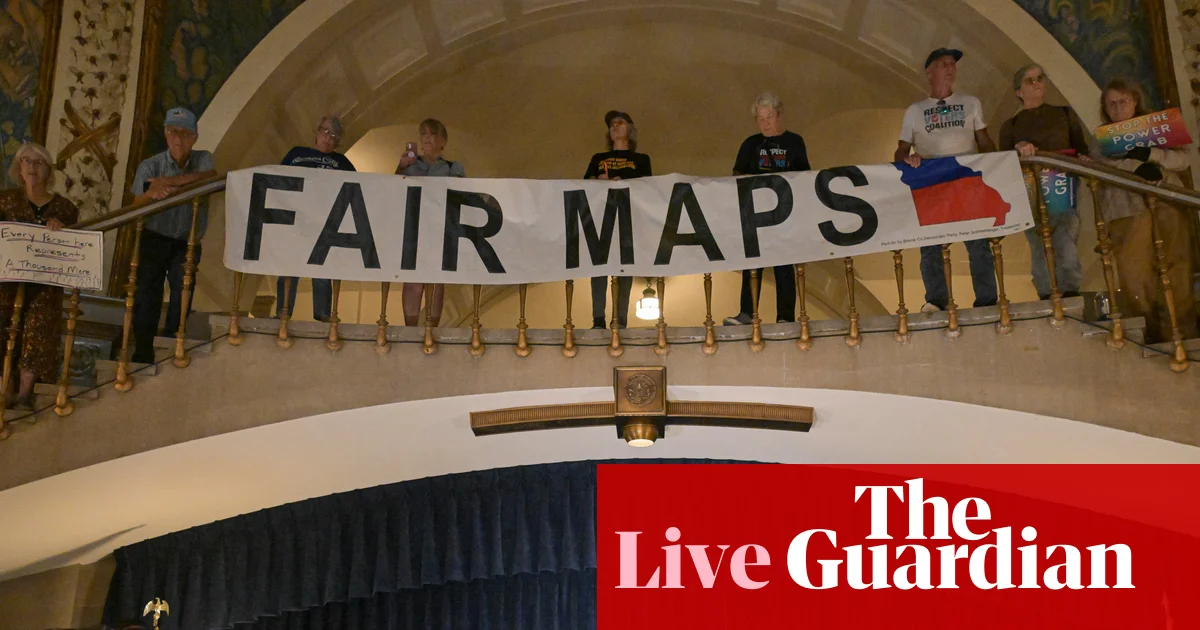
The Supreme Court has, for a third time, blocked Missouri from using a Republican-drawn congressional map for the November midterm elections, ensuring the 2022 district lines will remain in place. The decision halts a recent 8th Circuit Court of Appeals ruling that had reinstated the map, which was designed to give Republicans an advantage in seven of the state’s eight House districts. The back-and-forth legal battle occurred as absentee voting was already underway in Missouri, prompting the court to cite potential “electoral chaos” as a reason to maintain the existing map.
The dispute began after the Missouri Supreme Court ruled earlier this month that a citizen petition to put the 2025 map to a vote meant it never went into effect, despite being used in the August primaries. Republican Secretary of State Denny Hoskins was criticized for proceeding with the new map before voter approval. While Republicans argued over a million Missourians had already voted using the map, opponents contended voters hadn’t approved it and accused GOP officials of attempting to force through the new boundaries.
This is the third time the Supreme Court has intervened, previously blocking the map twice before. The court’s decision applies to the 2026 election as well, preventing further legal challenges to the map’s use beyond this cycle. The Democratic Congressional Campaign Committee chair, Suzan DelBene, stated the ruling is “a lever for Republicans to pull to misinform and scare away legal voters.”
While the immediate legal battle over the map is resolved, the case highlights a broader pattern of partisan map-drawing and legal challenges surrounding redistricting. The decision leaves the older map in place for the 2026 election, but the underlying issues of voter access and fair representation remain.
Where they differ
- The Democratic Congressional Campaign Committee’s statement, framing the ruling as a Republican attempt to suppress voters, was highlighted by left-leaning outlets like the Guardian and NPR, while right-leaning Fox News did not include this perspective.
- CBS News and the New York Times focused on the legal reasoning behind the Supreme Court’s decision, detailing the back-and-forth rulings from various courts, while other outlets presented a more concise overview.
- Fox News emphasized that the ruling applies to the 2026 election, framing it as ending the immediate legal wrangling, while other sources focused on the impact for the current midterm elections.
- The Hill noted the map was part of a nationwide strategy by former President Trump to draw more GOP-leaning seats, a detail not prominently featured in all reports.
What is not yet known
- The long-term impact of the court’s decision on Missouri’s congressional representation remains to be seen.
- The extent to which the Republican party will pursue further legal challenges to the map in future election cycles is unclear.
Background
- The Missouri Supreme Court authorized a citizen petition to put a 2025 congressional map to a vote, meaning it hadn’t officially gone into effect despite use in August primaries [Fact Refinery, 2026-09-10].
- This is not the first time the Supreme Court has blocked this particular map; it previously intervened twice before [Fact Refinery, 2026-09-10].
- Missouri’s current congressional delegation consists of six Republican and two Democratic seats, with the challenged map aiming to shift this to seven Republican and one Democratic [Fact Refinery, 2026-09-10].
- The SAVE program, a federal database used for citizenship verification, was expanded by the Trump administration to include Social Security Administration data, raising concerns about potential inaccuracies and voter purges [Fact Refinery, 2026-09-25].
- In 2026, the Supreme Court temporarily allowed the Trump administration to use the expanded SAVE database despite lower court rulings finding the changes likely unlawful [Fact Refinery, 2026-09-25].
Our reading
Our reading is that the Supreme Court’s repeated interventions in this Missouri redistricting case demonstrate a willingness to prioritize procedural regularity, specifically, preventing potential “electoral chaos”, over substantive arguments about partisan map-drawing. The court appears to be prioritizing the stability of the election process, even if it means maintaining a map opponents claim is unfairly biased. The differing media coverage, with some outlets focusing on legal reasoning and others on accusations of voter suppression, suggests a polarized understanding of the situation.
What to watch
- The 8th U.S. Circuit Court of Appeals’ ruling on the map, as the Supreme Court’s decision pauses the lower court order pending that appeal [Fact Refinery, 2026-09-10].
- Any further legal challenges by the Republican party to the map in future election cycles, given the court’s decision applies to the 2026 election as well [article text].
- Whether the Missouri Secretary of State, Denny Hoskins, complies with the Supreme Court’s decision and directs election officials to use the 2022 map, given his previous defiance of court rulings [Fact Refinery, 2026-09-09].
💬 Comments
📜 Comment Policy