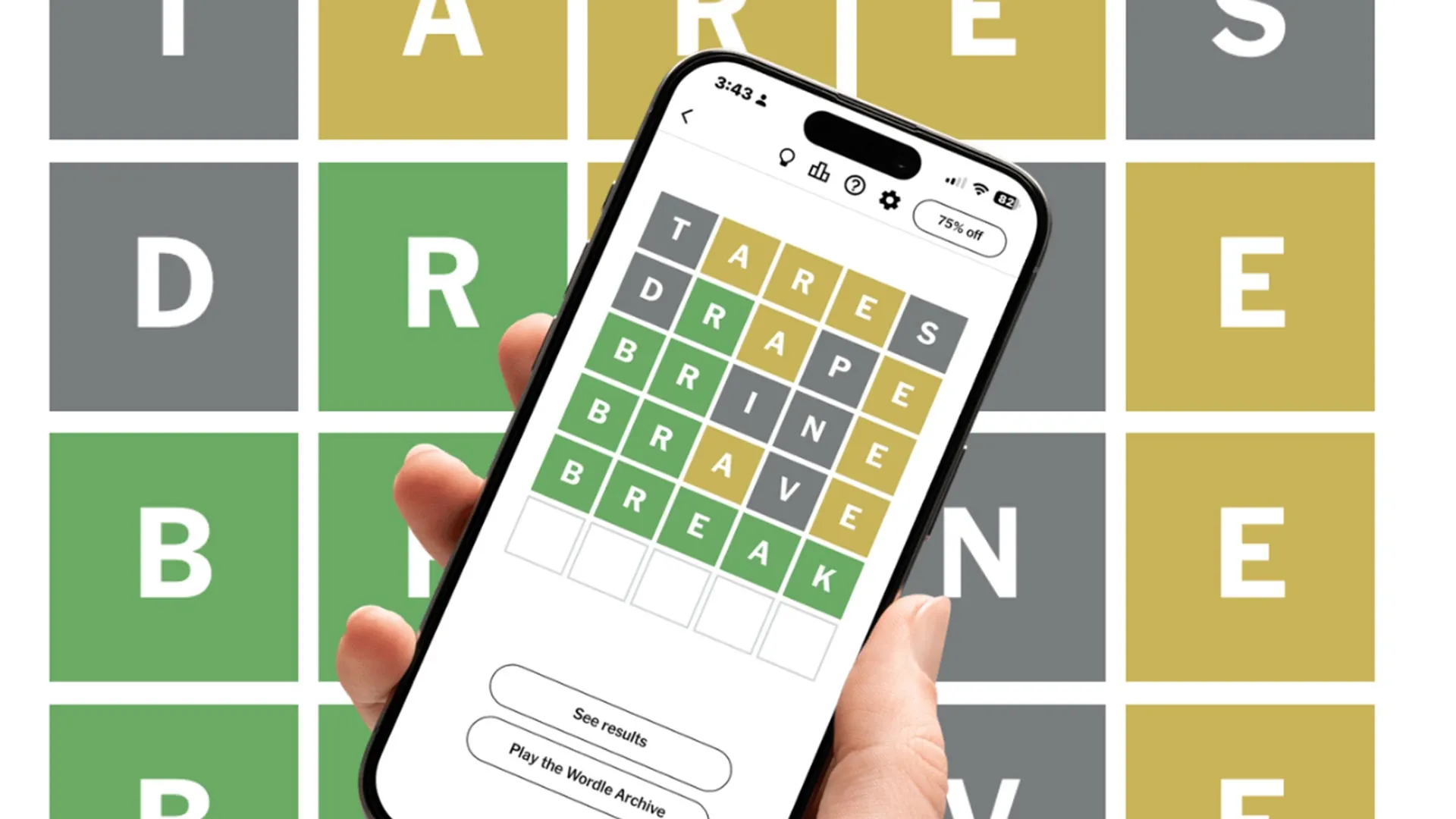
Researchers have successfully developed a new strategy for solving the popular word puzzle game Wordle that achieves a success rate of 99 percent. This method significantly outperforms traditional tactics by shifting the focus from guessing likely answers to maximizing information gain.
The core of this approach relies on Shannon entropy, a concept from information theory used to quantify uncertainty. By applying this mathematical framework, the researchers identified specific guesses that reveal the most about the hidden word with each attempt. Each guess is strategically designed to slash uncertainty and narrow down the remaining possibilities at a faster rate than conventional methods.
Traditional Wordle tactics often involve selecting words based on their frequency in the English language or their likelihood of containing common letters. While these strategies have merit, they do not always provide the most efficient path to the solution. The new method prioritizes the reduction of the search space over the probability of a word being correct immediately.
This data-driven approach allows players to eliminate large groups of potential words more effectively. By focusing on the information revealed by the game's feedback system, the strategy ensures that every guess contributes maximally to solving the puzzle. The result is a highly optimized process that minimizes the number of attempts required to find the correct answer.
The study highlights how principles from computer science and mathematics can be applied to everyday games to enhance performance. It demonstrates that understanding the underlying mechanics of information distribution can lead to superior outcomes in problem-solving scenarios. This research provides a clear example of how theoretical concepts can have practical applications in recreational activities.
We don't rate truth. We strip the spin and show you which perspectives covered the story. You decide.
Read the original coverage
💬 Comments
📜 Comment Policy