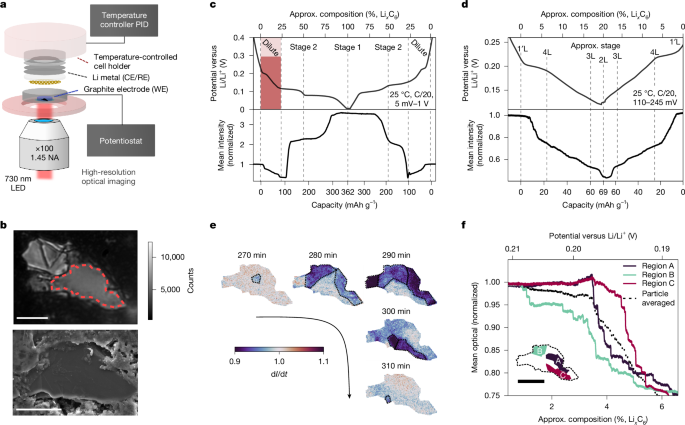
Researchers have observed avalanche-like lithium deintercalation processes within graphite, offering new insights into the dynamics of lithium-ion battery electrodes. The study, published in *Nature* on July 29, 2026, utilized operando optical microscopy to visualize these events at a microscopic level.
The research team focused on understanding how local disorder influences phase transitions and ion transport within graphite during charging and discharging cycles. Their observations revealed that as the dilute stages of graphite are emptied (during discharge) or filled (during charge), lithium ions don’t move uniformly. Instead, they deintercalate – or intercalate – in bursts resembling avalanches.
The study's methodology involved operando optical microscopy, a technique allowing real-time observation of material changes during operation. This allowed the researchers to directly witness the localized nature of these phase transitions and how they impact ion transport. The findings demonstrate that local disorder plays a crucial role in governing these dynamics.
The implications of this research extend to improving lithium-ion battery performance and longevity. By understanding the mechanisms behind these avalanche-like processes, scientists can potentially engineer electrode materials with enhanced stability and efficiency. The study’s doi is 10.1038/s41586-026-10862-4.
We don't rate truth. We strip the spin and show you which perspectives covered the story. You decide.
Read the original coverage
💬 Comments
📜 Comment Policy