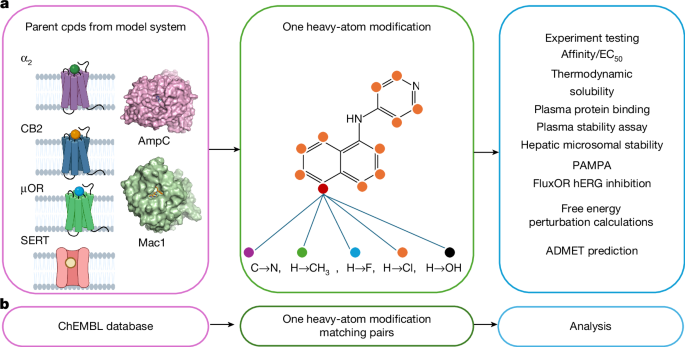
Researchers have established a random background expectation for ligand optimization, a crucial process in drug discovery. A study systematically modifying 18 lead molecules across six targets found that 11.3% of random, single-atom perturbation analogues improved potency by tenfold or more. However, these improvements often came at the cost of in vitro pharmacokinetics.
Ligand optimization is central to developing effective chemical probes and drugs, as initial active molecules often lack the necessary potency or pharmacokinetic properties for use in living organisms. The process involves synthesizing hundreds or even thousands of analogues to improve upon an initial ‘hit’ molecule. While strategies to improve this process exist, their efficiency has been unclear due to the lack of a random benchmark for comparison.
The research team aimed to establish this benchmark by systematically modifying 18 lead molecules across six targets, creating and testing 257 compounds. They used a tenfold improvement in potency as a measure of substantial impact. The results showed that 11.3% of the random analogues achieved this level of improvement, a figure surprisingly close to the 10% observed in the ChEMBL database. However, these more potent analogues generally exhibited worse in vitro pharmacokinetics.
While it was sometimes possible to find analogues where increased potency compensated for poorer exposure and half-life, leading to more potent compounds in vivo, the study revealed a generally ‘frustrated landscape’ for ligand optimization. This suggests that improving potency alone is not enough and that pharmacokinetic properties are a significant challenge in drug development. The study offers a simple strategy for establishing a background expectation for ligand potency optimization and quantifying the challenges of moving beyond in vitro potency.
Read the original coverage
💬 Comments
📜 Comment Policy