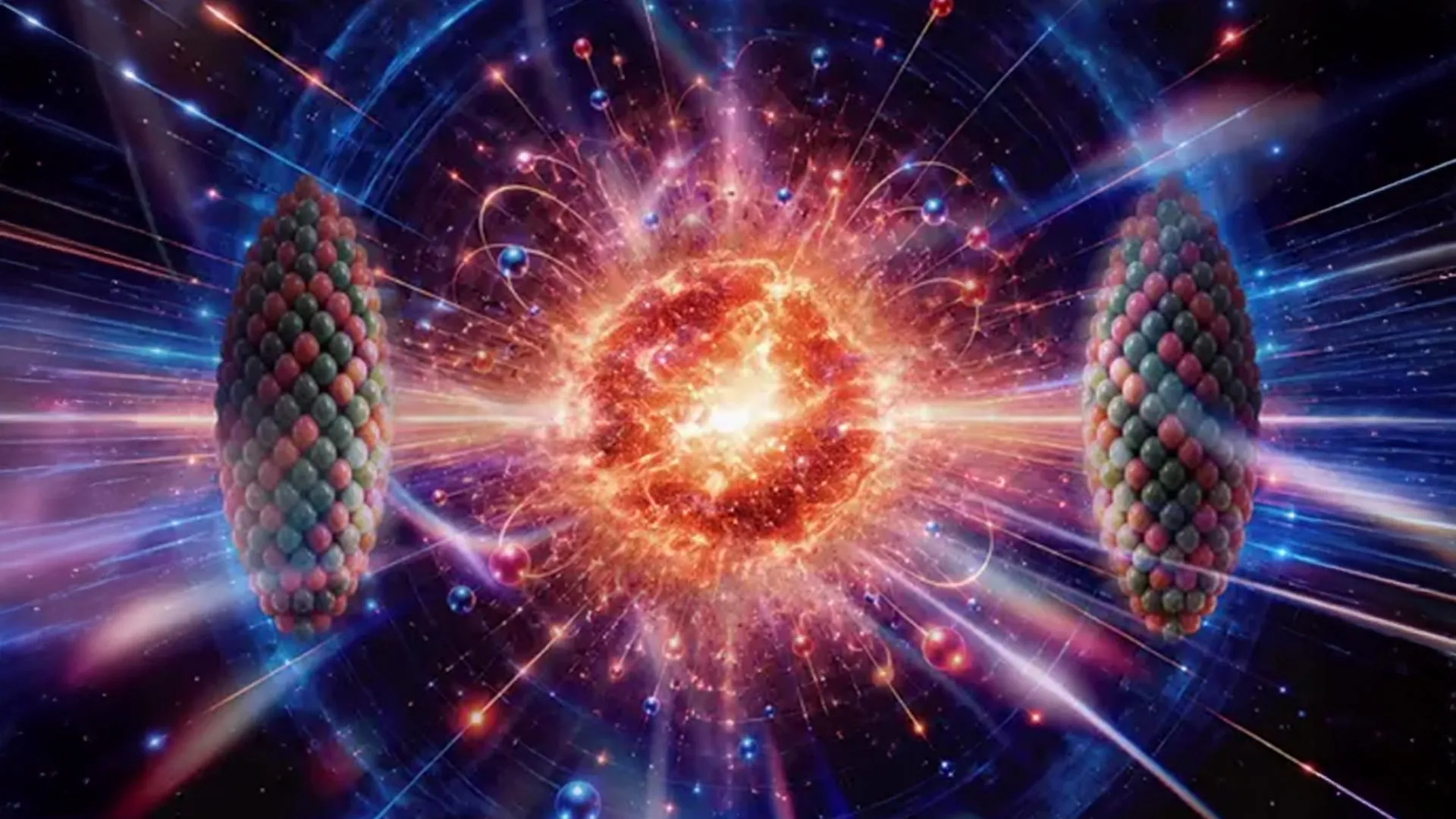
Scientists have identified a previously overlooked force influencing the behavior of quark-gluon plasma, the hottest fluid in the universe. New simulations show that extreme acceleration along the edges of this plasma drives its expansion and may affect its temperature, particle spins, and matter transitions.
When atomic nuclei collide at nearly the speed of light, they create quark-gluon plasma. Researchers have now discovered that extreme acceleration builds up around the perimeter of this fluid. This acceleration isn’t just moving the plasma; it appears to be a fundamental force shaping its properties.
The simulations reveal this edge acceleration may significantly alter the temperature-like behavior of the quark-gluon plasma. Furthermore, scientists believe it could influence the spins of particles within the plasma and even change how matter transitions between different states. The research provides new insights into the extreme conditions immediately following such high-energy collisions.
The study highlights a potential gap in current understanding of this exotic state of matter. By identifying acceleration as a key driver, scientists hope to refine models of quark-gluon plasma and gain a more complete picture of the forces at play in these incredibly energetic events.
We don't rate truth. We strip the spin and show you which perspectives covered the story. You decide.
Read the original coverage
💬 Comments
📜 Comment Policy