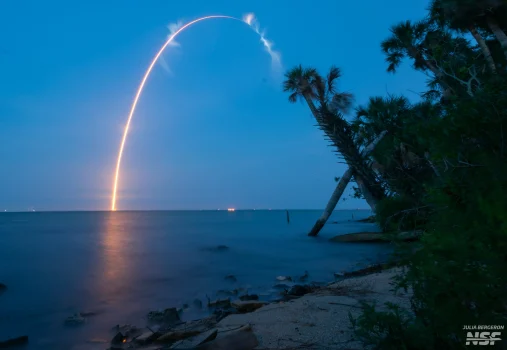
Nine orbital launches are scheduled to take place globally this week, including missions from the United States, Europe, and China. Launches include Earth observation satellites, communications payloads, and a cargo delivery to the International Space Station.
A Vega C rocket launched from the Guiana Space Centre in French Guiana on Tuesday, Sept. 15, at 01:21 UTC. The medium-lift vehicle delivered two payloads developed by Thales Alenia Space to a Sun-synchronous orbit (SSO): Sentinel-3C, an 1,143 kg Earth observation satellite developed by the European Space Agency (ESA) under the Copernicus program, and FLEX, which will gather information about plant health. The Vega C is an expendable, four-stage vehicle capable of delivering up to 2,300 kg to SSO. Its first three stages utilize solid rocket motors fueled by Hydroxyl-terminated polybutadiene (HTPB), ammonium perchlorate (AP), and aluminum powder (Al), while the fourth stage, the Attitude & Vernier Upper Module (AVUM), uses Unsymmetrical dimethylhydrazine (UDMH) and dinitrogen tetroxide (N2O4).
Also on Sept. 15, a ZhuQue-2E, developed by Landspace, launched from the Jiuquan Satellite Launch Center in China at 06:26 UTC. The vehicle launched to polar orbit carrying ten communications satellites for the SpaceSail Polar Group. The two-stage ZhuQue-2E produces 3,312 kilonewtons (kN) of thrust at liftoff, powered by four TQ-12A gas-generator cycle engines fueled by methane (CH4) and liquid oxygen (LOX) in its first stage, and a single TQ-15 engine with the same propellants in its second stage. This was the third mission for a ZhuQue-2 and the ninth overall.
Orienspace’s Gravity 1 is expected to launch from the Haiyang offshore launch location in China on Sept. 15, during a 21-minute window beginning at 09:50 UTC. The four-stage vehicle will launch on a southerly trajectory to deliver an unknown payload to low-Earth orbit (LEO), utilizing seven solid-rocket boosters during ascent, with four igniting at liftoff.
Read the original coverage
💬 Comments
📜 Comment Policy