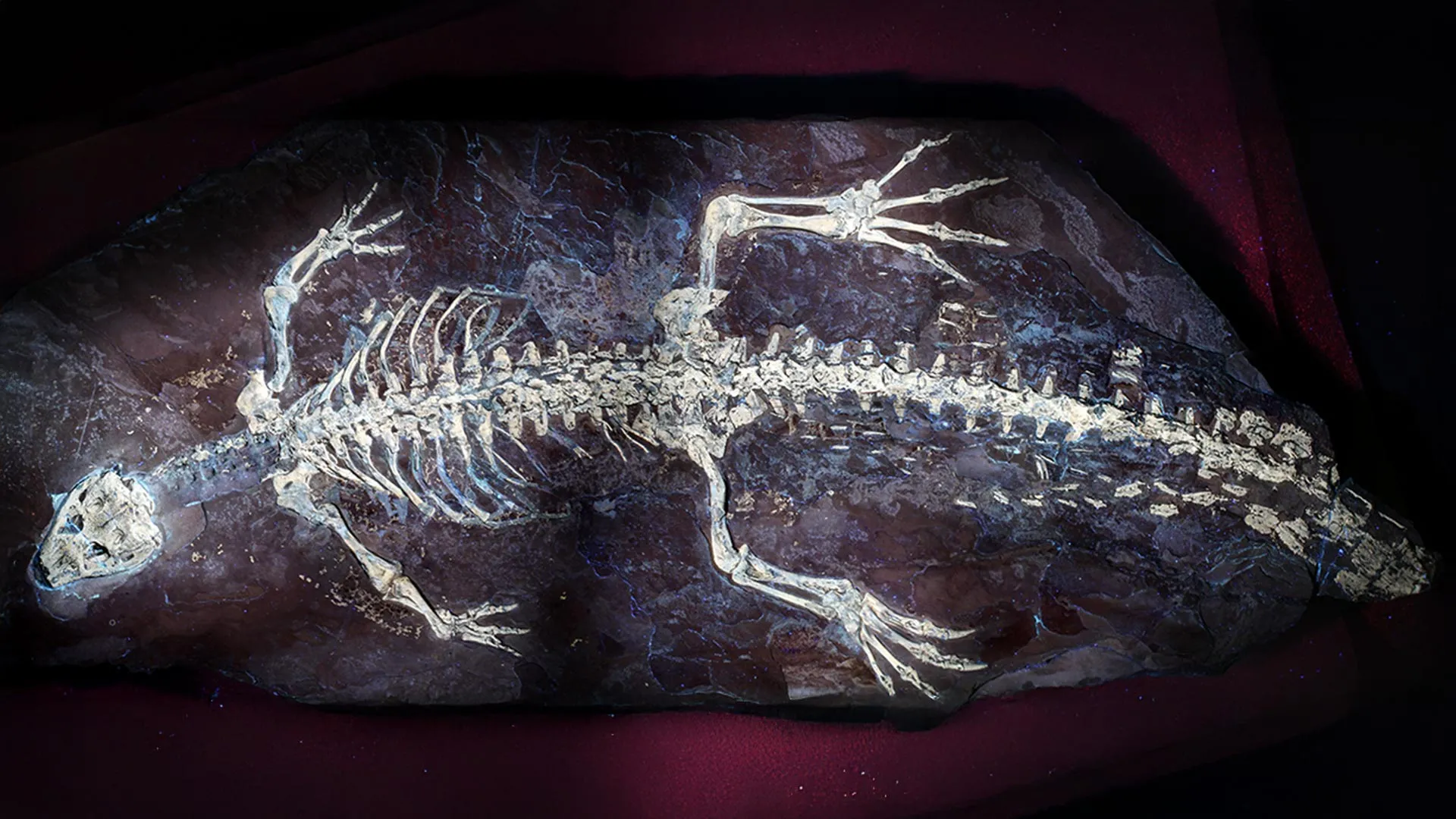
A 125-million-year-old crocodile fossil, *Montsecosuchus depereti*, is yielding new insights into the skin, sensory organs, respiratory structures, and potential coloration of ancient crocodylomorphs. Researchers at the Institute of Industrial Science, The University of Tokyo, and the Institut Català de Paleontologia Miquel Crusafont used ultraviolet light to reveal previously unseen details in the fossil, discovered in northeastern Spain.
The fossil, cataloged as MGB-512 and housed at the Museum of Natural Sciences of Barcelona, represents a small crocodile approximately 50 centimeters long that lived around 125 million years ago in a karstic lake near the Catalan Pre-Pyrenees. The sediments where the crocodile’s body settled became lithographic limestones within the UNESCO Orígens Global Geopark, contributing to the exceptional preservation of the specimen. While discovered over a century ago and studied in the 1990s, recent work by paleontologists Oscar Castillo and Jesús Serrano has uncovered previously hidden information about its soft tissues.
The breakthrough came while Castillo and Serrano were compiling a database of fossils from the Montsec limestones. Examining the *Montsecosuchus depereti* holotype under ultraviolet light revealed structures indicative of soft tissue remnants. “UV light allows us to see details that would otherwise remain completely hidden in the rock,” explains Oscar Castillo-Visa, first author of the study published in the Zoological Journal of the Linnean Society. The technique allowed the team to document epidermal scales and other soft tissues.
Notably, the ultraviolet light exposed alternating bands on the crocodile’s tail, suggesting a possible camouflage pattern. Researchers believe this pattern may represent the oldest known coloration preserved in a crocodylomorph.
Read the original coverage
💬 Comments
📜 Comment Policy