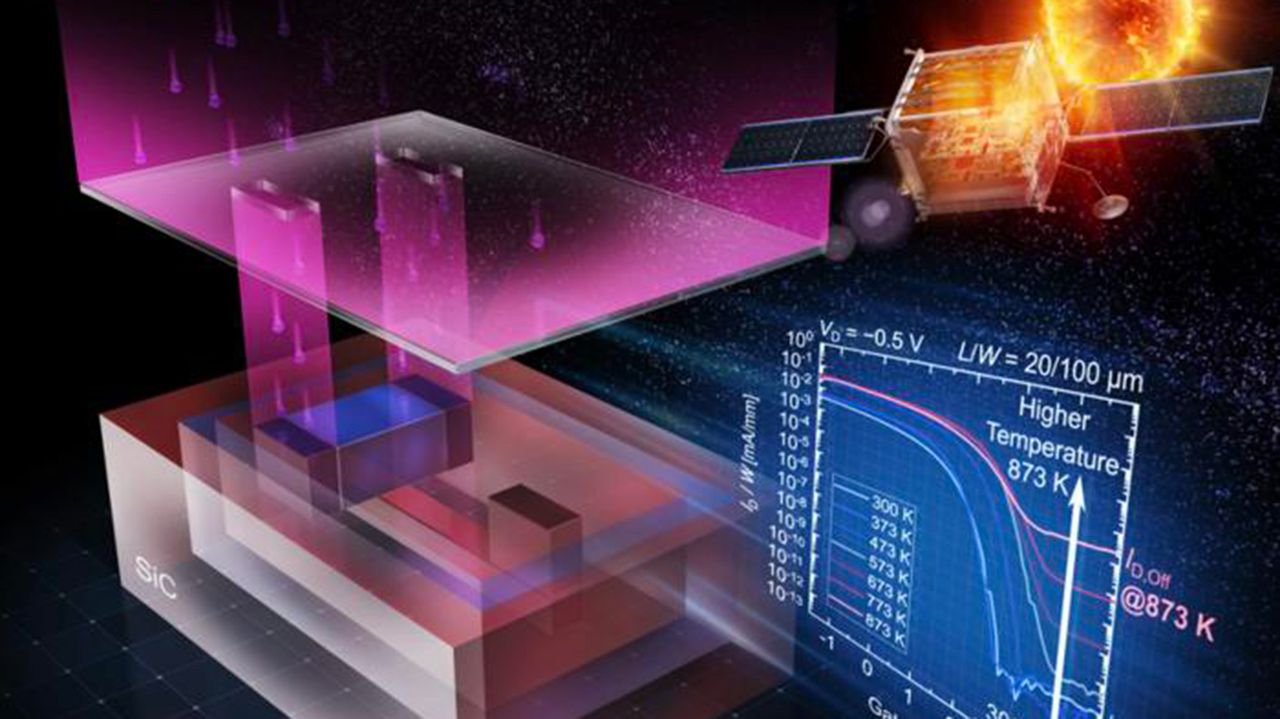
Scientists in Japan have developed a silicon carbide transistor capable of operating at 1,110 degrees Fahrenheit (600 degrees Celsius). This advancement addresses limitations of previous high-temperature transistors and could enable longer-lasting surface probes on Venus, where temperatures can reach 860 degrees Fahrenheit (460 degrees Celsius).
The new device is a junction field-effect transistor (JFET), chosen for its lower noise levels compared to more common metal-oxide-semiconductor field-effect transistors (MOSFETs). While JFETs are typically harder to scale down, they avoid issues with oxide layers that can cause interference. Researchers detailed their work in a study published August 17 in *APL Electronic Devices*.
Past Venus landers, such as the Soviet-era Venera 13, have been limited by the failure of silicon-based electronics, surviving for only a few hours. The research team notes that silicon carbide integrated circuits are “particularly attractive for extreme environments, such as deep-space exploration, geothermal drilling, and aerospace engine control, where conventional silicon-based ICs cannot operate reliably.”
Recent silicon carbide JFET developments have faced challenges with controllability and current leakage. The scientists discovered that doping the silicon carbide substrate with other atoms can cause variations in the electrical field at high temperatures, making the transistor less reliable. They found this could shift conventional JFET voltage thresholds by over 2 volts. Additionally, above 660 degrees Fahrenheit (350 degrees Celsius), the silicon carbide substrate can become less ele
Read the original coverage
💬 Comments
📜 Comment Policy