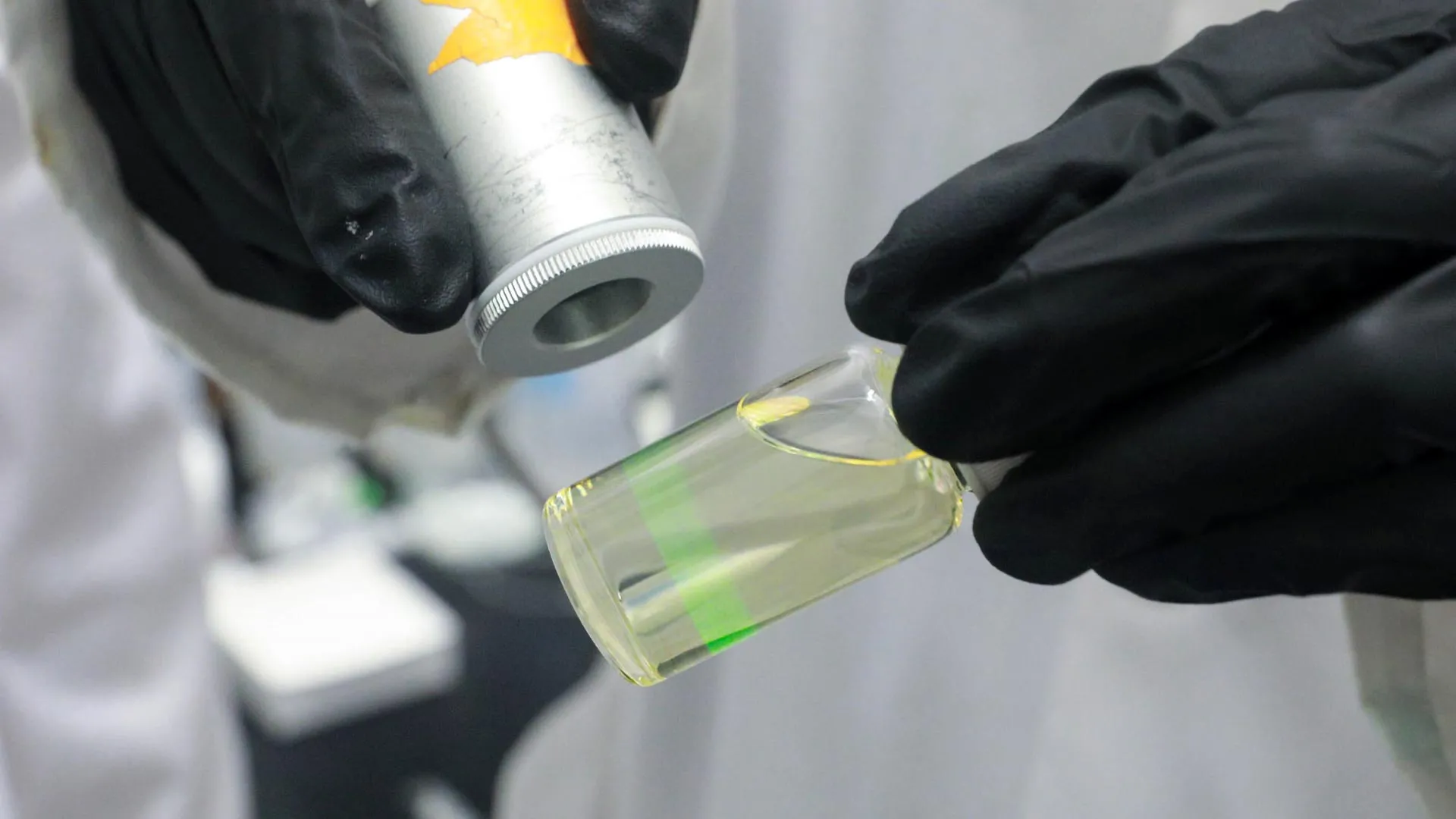
Engineers at the University of Toronto have developed ultra-bright nanoparticles capable of detecting minute amounts of chemicals and distinguishing between nearly identical molecules. The technology utilizes a process called upconversion, allowing the particles to absorb low-energy photons and emit higher-energy ones, creating a bright optical signal.
The new dye-sensitized nanoparticles could offer a more affordable method for identifying impurities in pharmaceuticals and tracing chemical pollutants in environments like groundwater. The particles function by producing a light signal when they attach to the chemical they are designed to detect. They absorb low-energy photons and convert that energy into higher-energy photons, resulting in a bright optical signal measurable by researchers.
According to Professor Kai Huang, senior author of a paper published in the *Journal of the American Chemical Society*, traditional fluorophores used to absorb and convert light only work in one direction, converting high-energy photons into low-energy photons. “What makes our dye-sensitized nanoparticles special is that they are capable of upconversion, meaning that they can absorb light in the form of low-energy photons and emit higher-energy ones,” Huang says.
This upconversion process provides a key advantage. Because the activating light has a different frequency than the emitted light, the desired signal can be more easily separated from background light. Huang explains this is “like the difference between stargazing at night versus the daytime,” noting that shifting the excitation frequency lower produces zero-autofluorescence background while the nanoprobes continue to glow.
Read the original coverage
💬 Comments
📜 Comment Policy