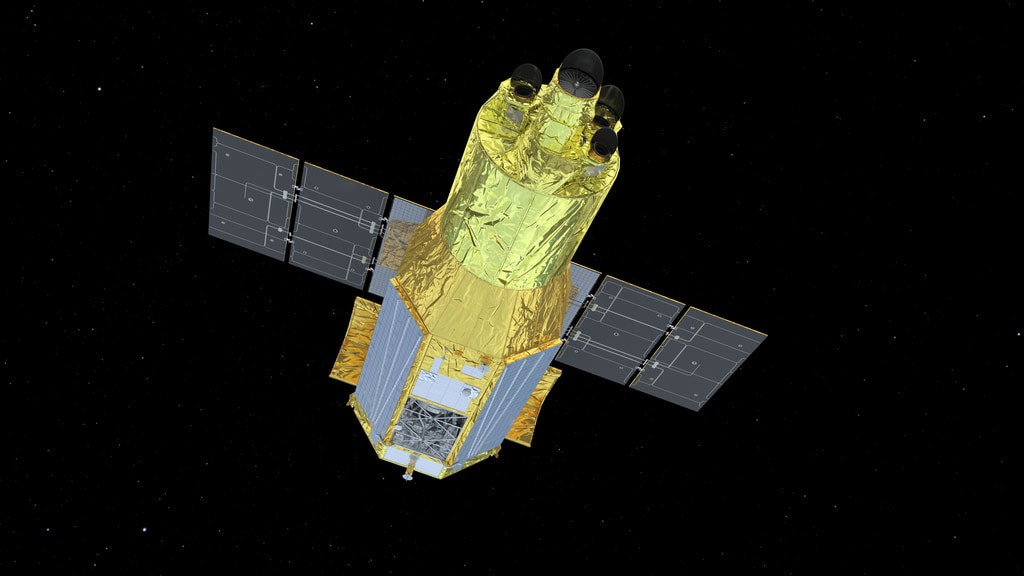
Using data from the Japan-led XRISM observatory, astronomers have directly observed a neutron star, GX 301-2, capturing stellar wind from its companion star, Wray 977, and using it as a power source for X-ray flares. The research, part of NASA’s exploration of the extreme universe, provides new insights into how these systems function.
The target system, BP Crucis, is located approximately 13,000 light-years away in the constellation Crux. Wray 977 is a blue hypergiant, 40 times the mass and 60 times the size of the Sun, constantly emitting ionized gas in a stellar wind. Its companion, GX 301-2, is a pulsar, a neutron star with a diameter of about 12 miles that rotates every 11 minutes and emits an X-ray beam. Strong X-ray flares occur twice during the pulsar’s 41.5-day orbit, near its closest and farthest points from the primary star.
Roi Rahin, a researcher at UMBC (University of Maryland, Baltimore County) and NASA’s Goddard Space Flight Center in Greenbelt, Maryland, stated, “We’ve never before seen clear indications of wind plasma falling onto a compact object.” Researchers believe the pulsar’s gravity creates a dense stream of plasma, and flares occur when the pulsar captures matter from this stream. The strongest flares happen when the pulsar is closest to the star, where the stream is densest.
On February 1, 2025, the XRISM observatory, with its Resolve instrument (developed jointly by NASA and JAXA), observed the system for 16 hours during a strong flare. The observatory captured detailed X-ray spectra, revealing rapidly changing emission and absorption lines. These lines showed the speed and direction of plasma near the pulsar. Rahin noted upon seeing the spectra, “It was clear that these observations were groundbreaking.”
Nazma Islam, a co-author formerly at UMBC and NASA Goddard and now an assistant professor at Manipal Centre for Natural Sciences, India, explained, “We could see how the dense stream of plasma acts very close to the neutron star.” Rahin and his team demonstrated that the observed iron absorption lines are displaced, providing evidence of the captured plasma. The findings were published Friday in the journal *Science Advances*.
Read the original coverage
💬 Comments
📜 Comment Policy