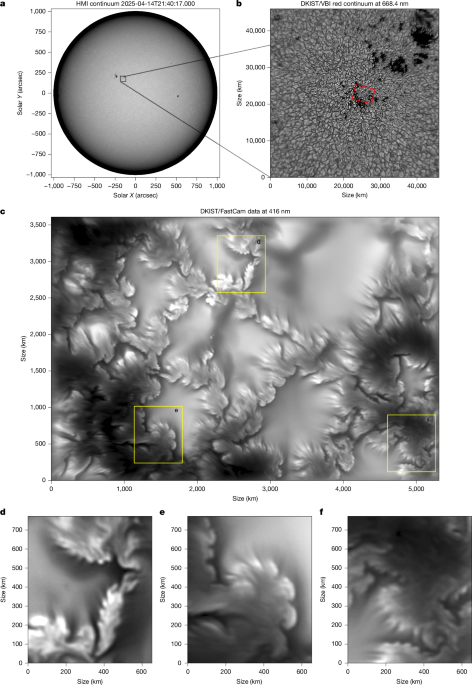
New high-resolution observations of the sun’s photosphere reveal a more complex and dynamic solar environment than previously understood. Researchers have discovered that Kelvin–Helmholtz instabilities are widespread and responsible for driving plasma mixing within the sun.
A study published online August 5, 2026, in *Nature* details how high-spatial-resolution observations of the solar photosphere show a far more complex and dynamic scene than previously observed. The research, identified by DOI: 10.1038/s41586-026-10871-3, focuses on identifying the mechanisms behind plasma mixing.
The findings demonstrate that ubiquitous Kelvin–Helmholtz instabilities drive this crucial process. These instabilities occur at the interface between fluids of different densities and velocities, causing them to mix. The observations reveal these instabilities are prevalent across the sun’s surface, suggesting they play a significant role in energy transport and magnetic field generation within our star.
We don't rate truth. We strip the spin and show you which perspectives covered the story. You decide.
Read the original coverage
💬 Comments
📜 Comment Policy