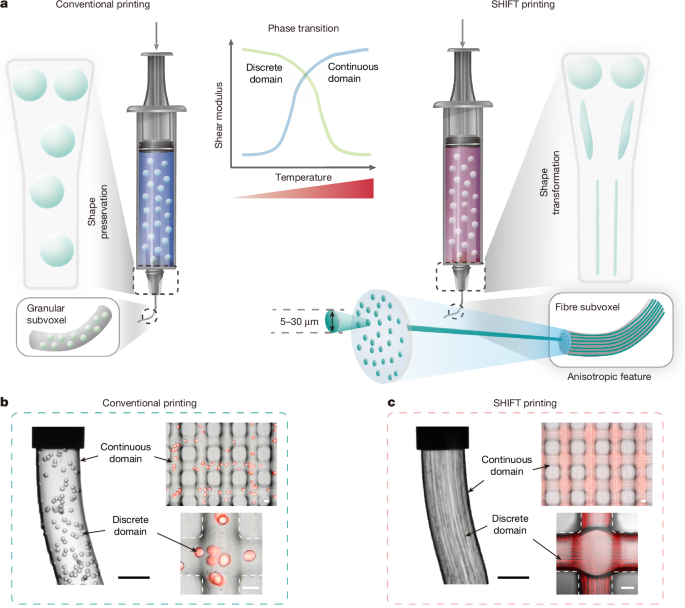
Researchers have developed a three-dimensional printing method that transforms hydrogel particles into aligned microfibres during the extrusion process. This innovation aims to create structural anisotropy, ultimately accelerating muscle tissue regeneration.
The new technique, detailed in a study published online August 5, 2026, by *Nature* (doi:10.1038/s41586-026-10883-z), focuses on altering the physical structure of hydrogels during printing. Traditionally, 3D printed materials often lack the aligned structures found in natural tissues.
The key to this advancement lies in the *in situ* particle-to-fibre transformation. As the hydrogel material is extruded during the 3D printing process, the particles are reshaped into microfibres that align with each other. This alignment creates what researchers call structural anisotropy – a property where the material’s characteristics differ depending on the direction measured.
The purpose of creating this anisotropic structure is to improve muscle tissue regeneration. The aligned fibres mimic the natural architecture of muscle, providing a scaffold that encourages cells to grow and organize in a way that promotes faster and more effective healing.
We don't rate truth. We strip the spin and show you which perspectives covered the story. You decide.
Read the original coverage
💬 Comments
📜 Comment Policy