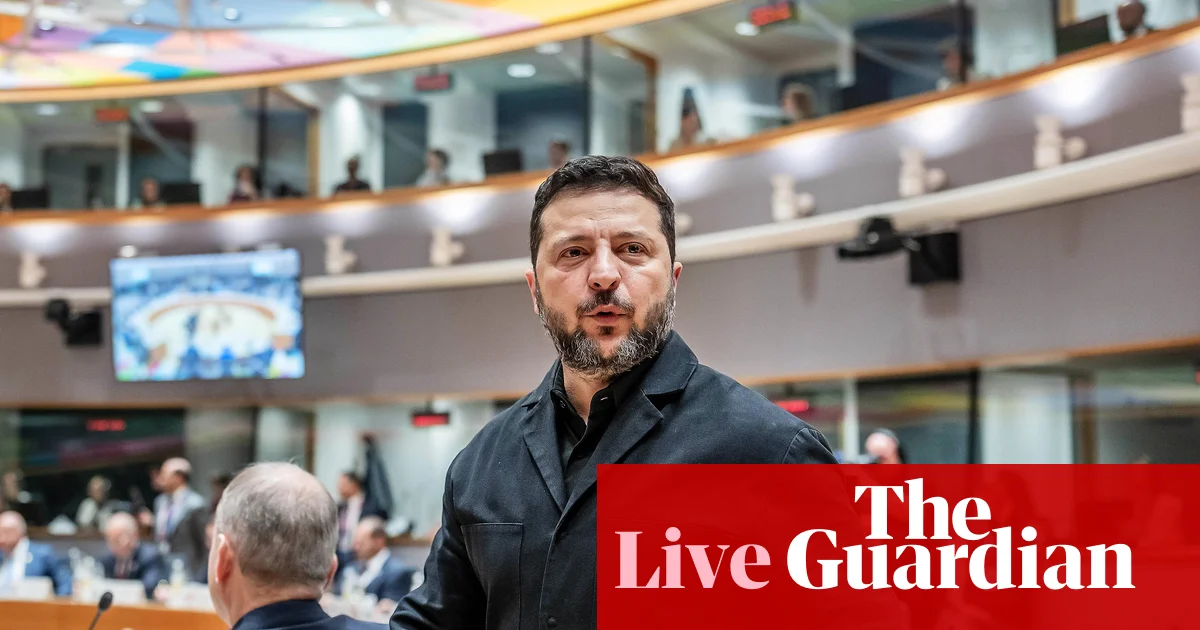
Ukrainian President Volodymyr Zelenskyy urged European leaders to maintain financial support for his country, warning that existing aid will soon be insufficient to sustain Ukraine’s defense and societal functions. Speaking at a summit in Brussels, Zelenskyy indicated Kyiv needs at least €70 billion in additional funding for defense and resilience, as the current €90 billion EU funding plan is expected to be depleted by 2026-27. The request comes as EU leaders consider how to utilize approximately €210 billion in frozen Russian assets to aid Ukraine, a plan facing opposition from Belgium, which hosts the majority of the funds and fears bearing the financial risk. Zelenskyy suggested establishing an EU-controlled custodian to manage the assets, reducing the risk of them being unfrozen and diverted. He also cautioned against Russia leveraging energy resources to undermine European support for Ukraine.
During a press conference, Zelenskyy responded with a smile to a question about whether he was being used as a scapegoat for domestic political issues in the United States, as suggested by former President Donald Trump. Belgium’s Prime Minister Bart De Wever stated Zelenskyy acknowledged the current funding would not last given the ongoing costs of the war, and asked if Europe was prepared to continue its financial commitment. Zelenskyy, in a released statement, described Russia as a long-term existential threat to Europe, noting Putin’s history of using energy as leverage even during earlier conflicts, such as the Chechen war.
Our reading is that Zelenskyy is attempting a multi-pronged approach to secure continued support for Ukraine, acknowledging the precariousness of both financial aid and military assistance. He is directly appealing to European leaders for funding while simultaneously addressing criticism from the US, specifically from Trump, and justifying strategic decisions like the renewed strikes on Russian oil refineries. The emphasis on Russia as an existential threat to Europe appears designed to bolster the case for sustained European commitment.
Read the original coverage
💬 Comments
📜 Comment Policy