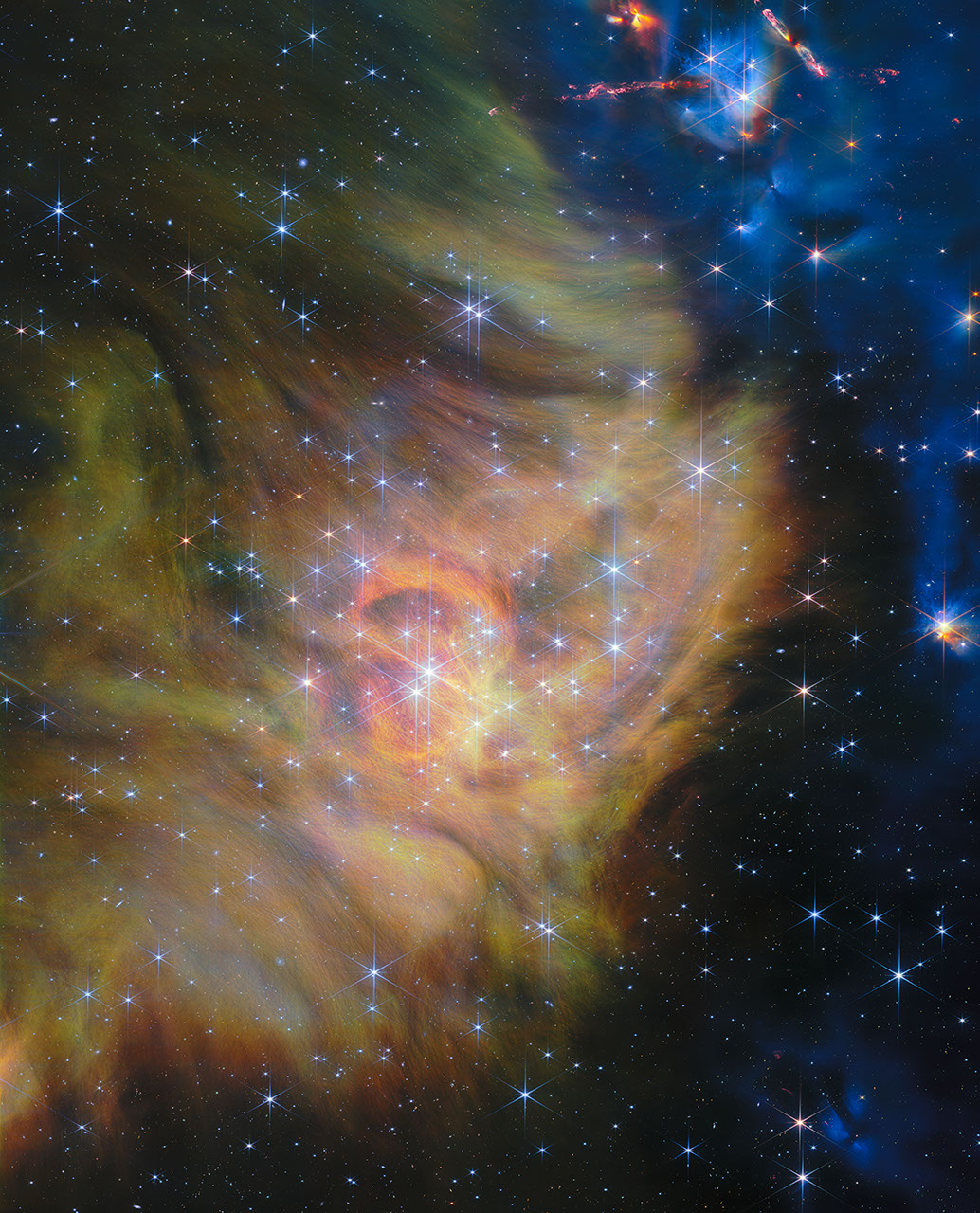
NASA’s James Webb Space Telescope has captured a detailed panorama of the IC 348 star-forming region, leading to the discovery of brown dwarfs with masses as low as twice that of Jupiter. This finding challenges existing theories about star and brown dwarf formation.
The star-forming region IC 348, located 1,000 light-years away in the constellation Perseus, is a site where cold clouds of molecular hydrogen gas collapse to create new stars and other celestial objects. Researchers used the Webb telescope to search for brown dwarfs within IC 348, which are objects smaller than stars that do not sustain hydrogen fusion.
Initial observations in 2022 revealed brown dwarfs with masses three to four times that of Jupiter. A more recent study, conducted in 2024 with Webb’s NIRCam and followed up with NIRSpec in 2025, uncovered even smaller brown dwarfs – some weighing only 0.19 percent of the Sun’s mass, or twice the mass of Jupiter. These are the least massive brown dwarfs discovered to date. The research team’s goal was to determine how small the smallest objects created by the star-formation process could be.
Notably, one of the lightest brown dwarfs discovered exhibits signs of a disk, suggesting the potential for planet formation around an object with planetary mass. This discovery challenges current models of star formation and opens new avenues for research into the creation of both stars and planets.
Read the original coverage
💬 Comments
📜 Comment Policy