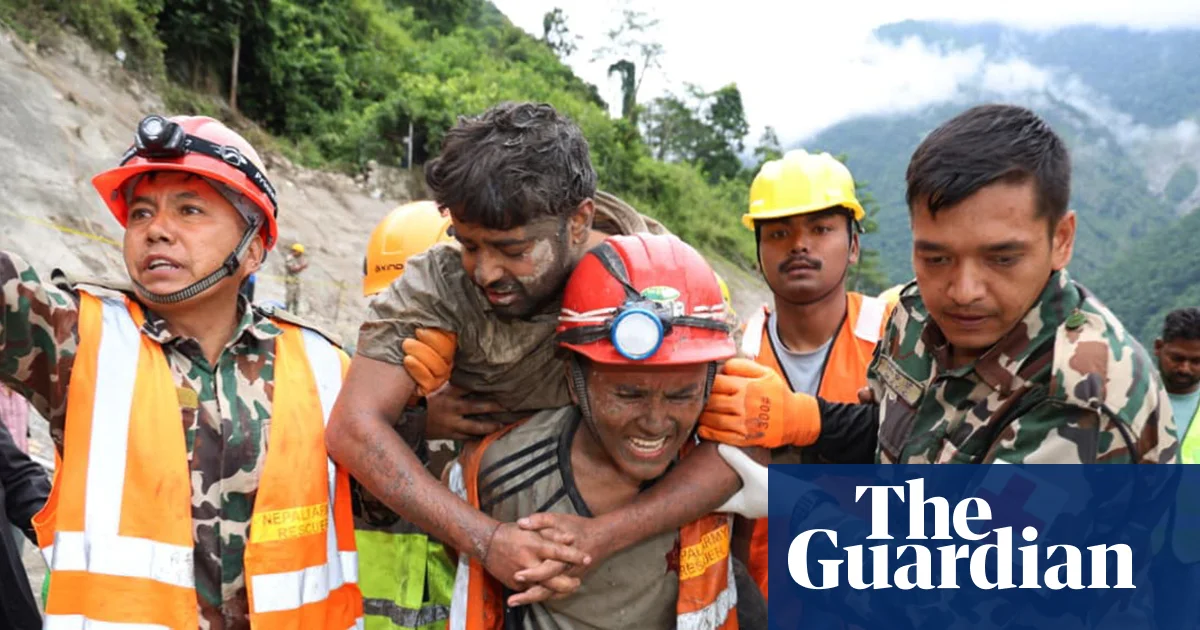
Two workers, Sanjay Shah and Kabir Maharjan, were rescued from a hydropower tunnel in Nepal nine days after deadly flash floods triggered by glacial collapse trapped them at the Trishuli 3A Hydropower Project. The rescue occurred at a depth of 170 meters within the tunnel, where voices had been heard after a breakthrough on Friday morning. Rescue workers responded to the workers with assurances of help, receiving an acknowledgement in return. The flooding, which occurred on the border between Nepal and Tibet, destroyed multiple hydropower projects along the Bhote Koshi and Trishuli rivers. While Shah, a foreman, was airlifted to a hospital northwest of Kathmandu, Maharjan, a supervisor, was reported to be thankful but unable to move his limbs.
Authorities estimate around 900 workers are missing from 12 hydropower projects, with roughly 500 believed to be trapped in tunnels, and over 270 have been rescued so far. At the Upper Trishuli 3A facility, it took six days to locate the tunnels due to thick mud. The Independent Power Producers Association of Nepal reports 557 workers are missing from projects along the Trishuli River, with about 115 trapped in the main tunnel. Rescue efforts are focused on air pockets within the tunnels, where workers may have survived.
At least 1,200 people have been confirmed dead, and more than 4,000 are missing overall. Thirty-three British nationals remain among the missing. Damador Acharya, a Nepalese charity worker, described the rescue operation as “terrifying” and difficult to access. Andy Burnham, in his first address to the House of Commons, connected the disaster to the climate crisis, noting the likely hottest summer on record. The search for 42 unaccounted workers at the Trishuli 3A plant continues, with officials hoping to save at least that many from the facility.
Read the original coverage
💬 Comments
📜 Comment Policy