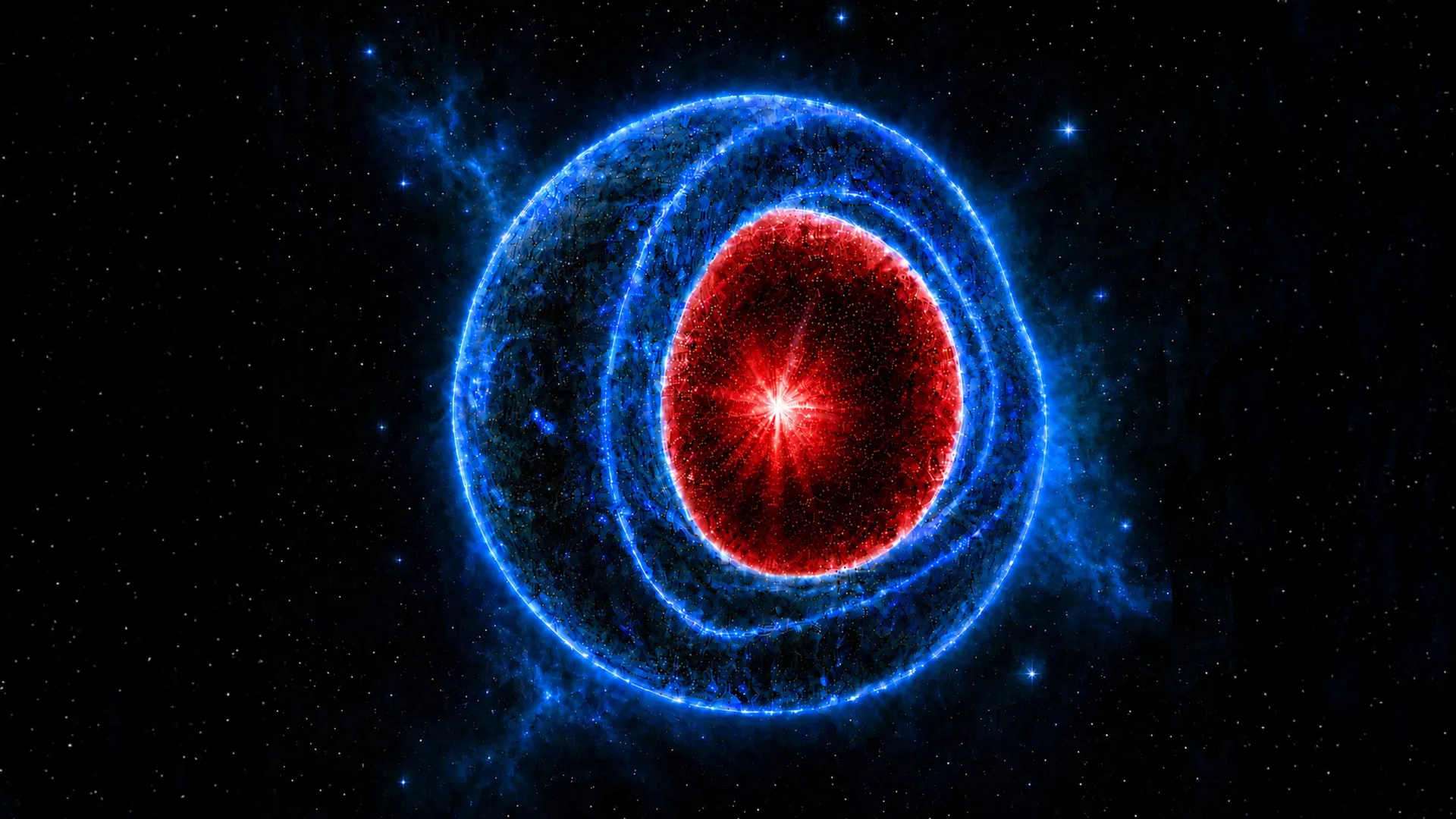
A new theoretical study challenges the conventional understanding of stellar collapse, proposing that massive stars may not always form black holes. Instead of collapsing into a singularity hidden behind an event horizon, the dying star could trigger the birth of a tiny new universe within itself.
According to the research, this internal miniature cosmos would be driven by dark energy. As it expands, this new universe would push back against gravity, effectively preventing complete collapse. This process results in the creation of an exotic object known as a gravastar.
The findings suggest that what astronomers have long identified as black holes might actually be these gravastars. The study posits that the intense gravitational forces typically associated with black hole formation are counteracted by the expansion of this newly formed internal universe. This mechanism offers an alternative explanation for the behavior of massive stellar remnants.
This theoretical framework provides a different perspective on the end stages of massive stars. It suggests that the boundary conditions usually thought to define a black hole's event horizon may instead serve as the gateway to a new, expanding cosmos. The role of dark energy is central to this model, acting as the force that sustains the gravastar structure against gravitational pull.
The implications of this study extend beyond simple stellar classification. If confirmed, it would fundamentally alter our understanding of cosmic evolution and the lifecycle of stars. The concept of a universe birthing within another challenges existing astrophysical models and opens new avenues for theoretical research into the nature of space-time and gravity.
We don't rate truth. We strip the spin and show you which perspectives covered the story. You decide.
Read the original coverage
💬 Comments
📜 Comment Policy