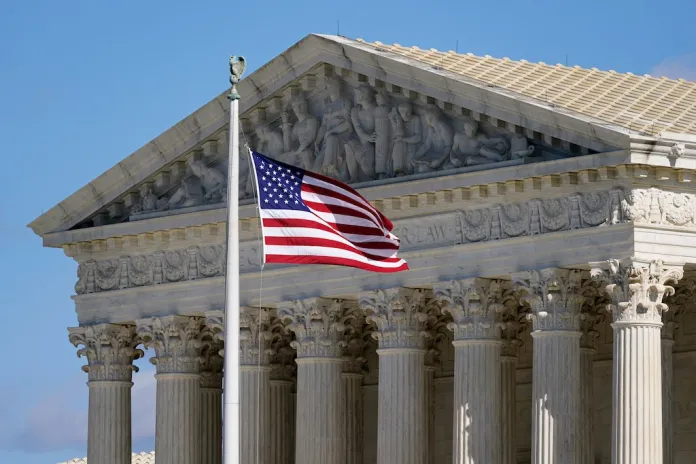
The Supreme Court issued a 6-3 ruling on Wednesday in Brnovich v. Democratic National Committee, upholding two Arizona voting restrictions and setting new standards for evaluating claims under Section 2 of the Voting Rights Act. The decision, written by Justice Samuel Alito, upheld Arizona's ban on ballot collection and its requirement that ballots cast in the wrong precinct be discarded. The majority opinion stated that Section 2 does not guarantee proportional representation for minority groups and outlined several guideposts for courts to consider when assessing whether a voting practice violates the law, including the size of the burden imposed, the state's justifications, and the extent of any racial disparity. The ruling was joined by the court's six justices appointed by Republican presidents.
Justice Elena Kagan wrote a dissent, joined by Justices Stephen Breyer and Sonia Sotomayor, all appointed by Democratic presidents. Kagan wrote that the majority had "rendered the Voting Rights Act a dead letter" and that the decision "makes a mockery of the statute." The majority opinion countered that "the mere fact that there is some disparity in impact does not necessarily mean that a system is not equally open or that it does not give everyone an equal opportunity to vote."
The case centered on Arizona's law prohibiting third-party collection of early ballots, often referred to as ballot harvesting, and its policy of not counting provisional ballots cast at the wrong precinct. The Democratic National Committee and other plaintiffs argued these measures disproportionately affected minority voters and violated Section 2, which prohibits voting practices that result in denial or abridgment of the right to vote on account of race or color.
President Joe Biden criticized the ruling, calling it an "assault on democracy" and urging Congress to pass the For the People Act and the John Lewis Voting Rights Advancement Act. Civil rights organizations also condemned the decision, arguing it significantly weakens the remaining protections of the Voting Rights Act after the Supreme Court's 2013 decision in Shelby County v. Holder, which struck down the preclearance requirement of Section 5.
Supporters of the ruling said it restores the original meaning of the Voting Rights Act, noting that the law's text states that minority populations have no collective right to representation equal to their share of the population. They argued that the decision corrects decades of lower court interpretations that had read Section 2 broadly to require maximization of minority voting power. The ruling sets out a framework that considers the totality of circumstances, including the state's interest in preventing fraud and promoting voter confidence.
The decision is expected to influence ongoing legal battles over voting laws passed in multiple states, as it provides a narrower path for plaintiffs to challenge such laws under Section 2. Congressional Democrats have renewed calls for legislation to strengthen voting protections in response to the ruling.
Read the original coverage
💬 Comments
📜 Comment Policy