Study Suggests Stellar Noise May Hide Alien Signals
A recent study published by SETI indicates that humanity may be missing extraterrestrial communications due to natural interference from stars. The research suggests that the primary obstacle in detecting alien messages is not their absence, but rather the distortion caused by the stars themselves before signals escape into space.
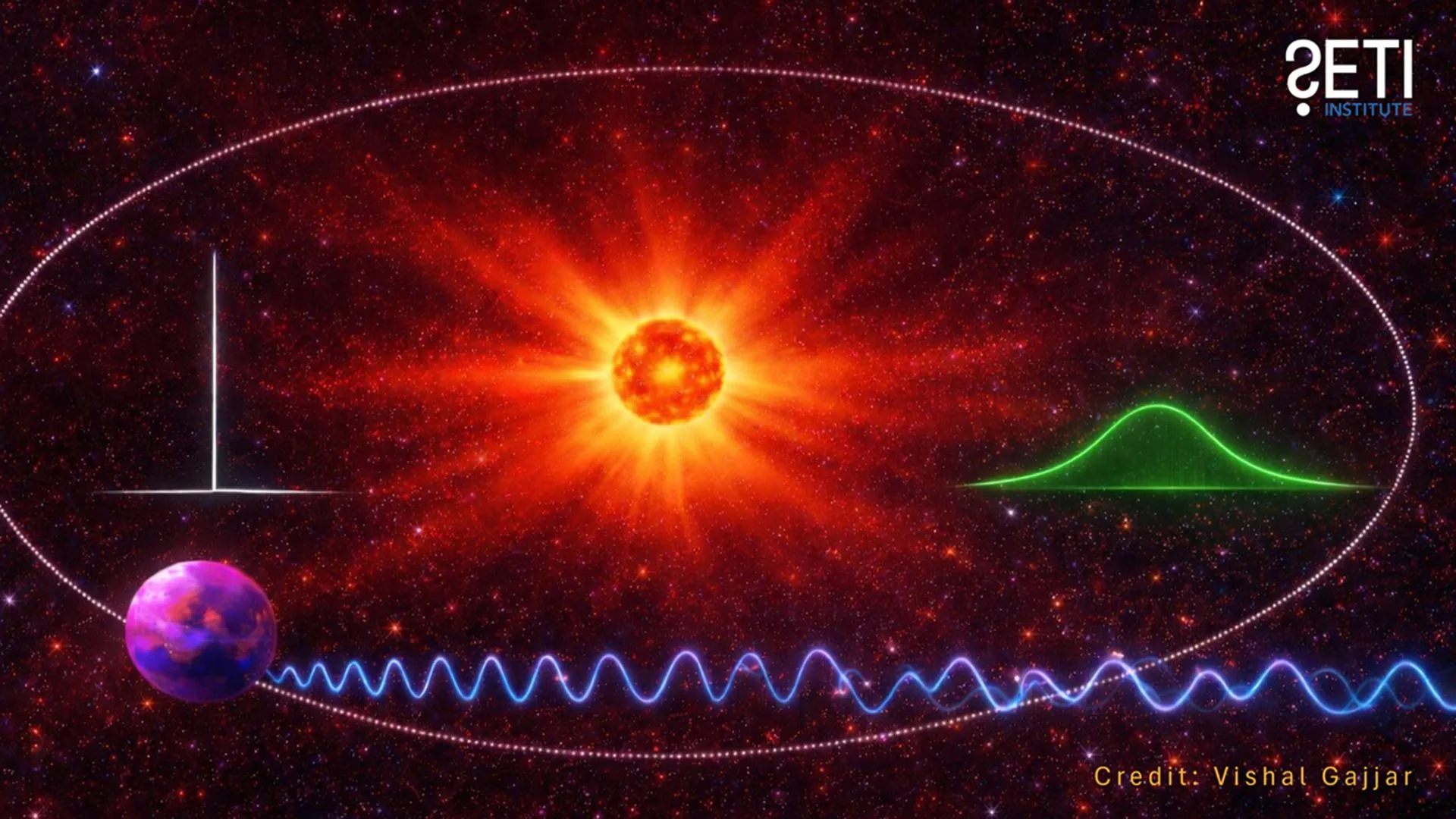
According to the findings, turbulent plasma and powerful stellar storms can significantly alter radio transmissions. These cosmic phenomena spread ultra-narrow radio transmissions across a wider range of frequencies. This scattering effect makes the signals much harder for traditional search methods to identify and isolate from background noise.
The study highlights that this interference is particularly significant around M-dwarf stars. These are the most common type of star in the Milky Way galaxy. Because M-dwarfs are so prevalent, the potential for signal scrambling affects a large portion of the sky where astronomers typically focus their search efforts.
This new perspective shifts the understanding of the challenges faced by the Search for Extraterrestrial Intelligence (SETI). Previously, the difficulty in detecting signals was often attributed to the lack of active communication from other civilizations. However, this research proposes that the signals may indeed be present but are rendered undetectable by the chaotic environment of their home stars.
The implications for future astronomical surveys are substantial. Traditional SETI protocols rely on identifying specific, narrow-band frequencies that stand out against the cosmic background. If stellar activity consistently broadens these bands, existing algorithms may fail to recognize valid extraterrestrial transmissions as such. Researchers must now account for this natural filtering process when analyzing data.
The study does not confirm the existence of alien life or communication. Instead, it provides a physical explanation for why previous searches have yielded negative results despite the vast number of potential target stars. By understanding how stellar environments affect signal propagation, scientists can refine their detection strategies to look for broader frequency ranges or adjust their sensitivity settings.
This research underscores the complexity of interstellar communication. It suggests that the universe may be noisier than previously thought, requiring more sophisticated tools and methods to pierce through the static generated by our own galactic neighborhood.
💬 Comments
📜 Comment Policy