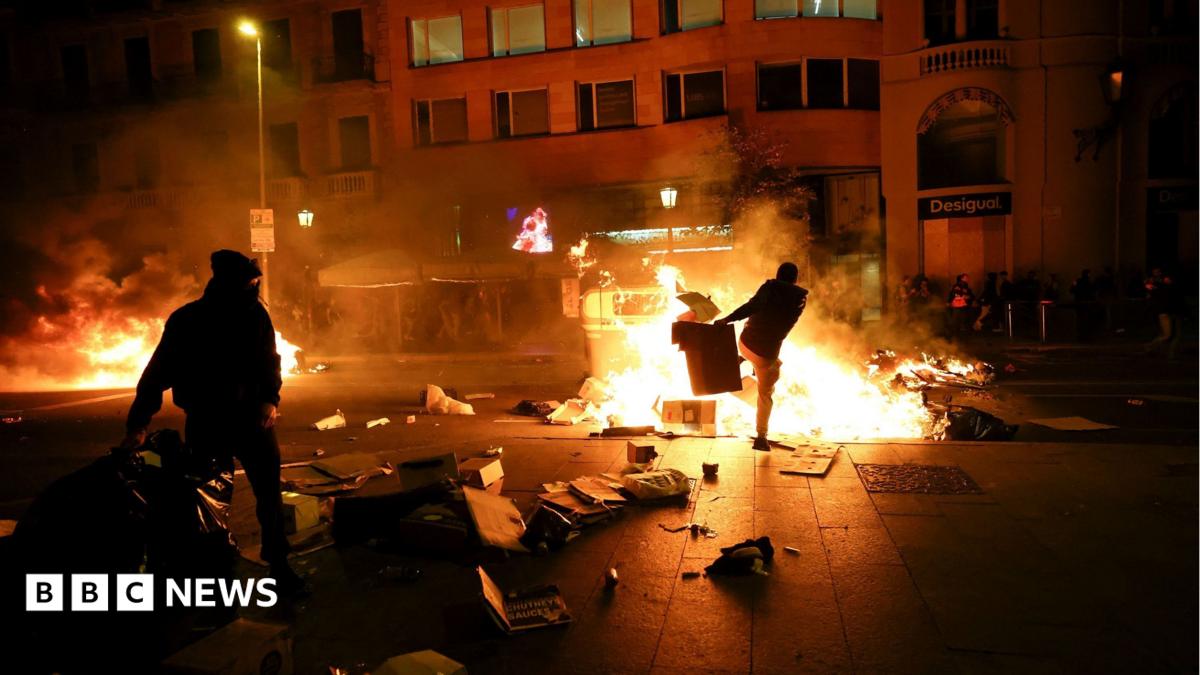
Spain experienced widespread disruption Wednesday due to a general strike called by major unions in response to rising living costs and a lack of affordable housing, with clashes erupting in Barcelona. The strike, the first in 14 years, comes as Spaniards prepare to vote in parliamentary elections on November 29th, following Prime Minister Pedro Sánchez’s decision to call a snap election after his housing reform plan failed to pass. Demonstrations took place across the country, with significant disruption reported in Madrid and Catalonia, including halted traffic and attacks on estate agencies. Eighteen people were arrested in Barcelona after protests turned violent, with masked demonstrators clashing with police and setting fires.
The strike was sparked by the eviction of 87-year-old Maricarmen Abascal from her Madrid home, where she had lived for seven decades, and her subsequent death in hospital. Rental costs in Madrid have soared, with the average monthly cost of a 50m sq apartment reaching €1,170 in October, nearly half the average gross monthly salary of €2,460. Union leaders, including Pepe Álvarez of UGT and Unai Sordo of CC OO, hailed the strike as successful with “massive” or “very significant” participation. However, the Spanish Confederation of Business Organisations described participation as “low and uneven.”
The political context is complex. Prime Minister Sánchez has publicly supported the right to strike and demand affordable housing, a move criticized by the conservative People's Party (PP), whose leader Alberto Núñez Feijóo called the strike “nonsense” and accused the unions of being a “mafia.” The PP alleges the government is attempting to exploit the strike for electoral gain. In Barcelona, municipal police estimated over 55,000 participants in the initial peaceful demonstration, while organizers claimed 400,000. Catalan President Salvador Illa condemned the violence that followed, stating it did not reflect the spirit of the protest. The unrest mirrors broader social discontent over housing affordability and inflation seen across Europe, including Portugal, Belgium, France, Italy, and Germany.
Our reading is that the strike represents a confluence of economic hardship and political maneuvering. The immediate cause, the death of Maricarmen Abascal, has clearly resonated, but the broader context of rising living costs and housing unaffordability suggests deeper discontent. The timing, so close to parliamentary elections, and the accusations leveled by the People’s Party indicate that political actors are attempting to capitalize on the situation, and the differing accounts of participation suggest a struggle to control the narrative.
Read the original coverage
💬 Comments
📜 Comment Policy