Russian Drone Strike Kills At Least 14 at Ukrainian Train Station
AI-synthesized · Bias removed · Facts only
3 sources: 1 left · 0 center · 2 right
Facts are sacred. Opinion is labelled.
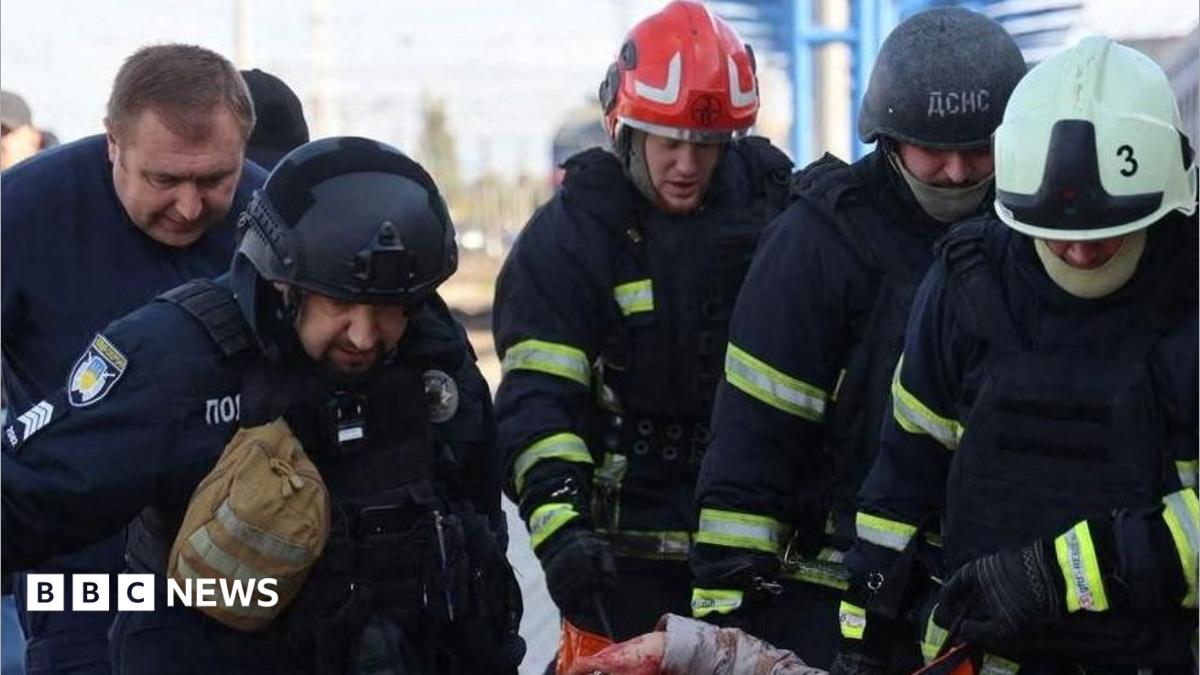
Image: Bbc Us
A Russian drone strike on a train station in Dnipro, Ukraine, killed at least 14 people and injured over 30 on Thursday, Ukrainian officials reported. The attack targeted a platform at Dnipro’s main station where a commuter train was preparing to depart for Zaporizhzhia. Authorities say the drone was jet-powered. The strike occurred despite an elevated threat level announced by Ukrainian Railways. In addition to the Dnipro attack, two girls were killed in Chernihiv and three people in Kremenchuk in separate Russian strikes. Ukrainian officials, including President Volodymyr Zelenskyy, have called for increased international sanctions against Russia, referencing recent easing of some restrictions on Russian diesel exports.
A localized, three-day humanitarian truce was reportedly holding in the Russian-occupied city of Oleshky, allowing for aid delivery, while Russia condemned Ukrainian drone attacks on Moscow during the Russia-Africa Summit. Moscow denies deliberately targeting civilians, claiming its railway attacks focus on military infrastructure. However, Ukrainian Prime Minister Sergiy Koretskyi stated, “Russia is deliberately hunting civilians: on trains, at stations, in residential buildings.”
Reports indicate an acute shortage of air defense missiles is contributing to the rising number of attacks on Ukrainian infrastructure. While a fragile ceasefire was in effect in Oleshky, Zelenskyy emphasized Russia’s continued attacks demonstrate a desire to prolong the war. French President Emmanuel Macron called for increased efforts to achieve a lasting peace and bring Russia to the negotiating table, criticizing Moscow’s rejection of peace proposals.
Where they differ
- The New York Post and Newsmax led with the immediate death toll of 14, while other sources initially reported 13 before updating to match.
- Left-leaning outlets, such as Meduza and DW, emphasized Zelenskyy’s criticism of eased sanctions on Russian diesel and oligarchs, framing it as a direct response to the attacks.
- Right-leaning coverage from the New York Post and Newsmax presented the attacks as part of a broader pattern of Russian targeting of civilians, while BBC and DW focused more on the logistical details of the strike and the ongoing humanitarian efforts in Oleshky.
What is not yet known
- The precise type of jet-powered drone used in the attack remains unspecified.
- The extent to which the recent easing of sanctions on Russia influenced the timing or scope of the attacks is not established.
Background
- Ukraine has been engaged in conflict with Russia since 2022, with Russia launching a full-scale invasion that year [background knowledge].
- A ceasefire was previously extended across Ukraine’s Kherson region to aid trapped residents in the Russian-occupied city of Oleshky, brokered with assistance from US First Lady Melania Trump and Pope Leo XIV [Fact Refinery, 2026-10-27].
- Former US President Donald Trump recently claimed a ceasefire agreement with Russia, a claim disputed by Ukrainian President Zelenskyy, and followed by further Russian strikes [Fact Refinery, 2026-10-12].
- The US recently agreed to temporarily suspend sanctions on Russian diesel exports, a move criticized by Zelenskyy as funding Russia’s war effort [Fact Refinery, 2026-10-11].
- Russia has increasingly used glide bombs in Ukraine, targeting residential areas and causing civilian casualties [Fact Refinery, 2026-08-03].
Our reading
Our reading is that despite localized humanitarian pauses and diplomatic efforts, Russia continues to actively prosecute the war in Ukraine, demonstrating a disregard for civilian life and international appeals for de-escalation. The differing media emphasis on sanctions relief and civilian targeting suggests a partisan framing of the conflict, with some outlets prioritizing logistical details while others highlight the moral implications of Russia’s actions. The reported shortage of air defense missiles appears to be exacerbating the impact of these attacks on Ukrainian infrastructure.
What to watch
- The outcome of the trilateral negotiations planned for November in Abu Dhabi, to see if a broader ceasefire agreement can be reached [Fact Refinery, 2026-10-27].
- Whether the reported easing of sanctions on Russian diesel exports leads to a measurable increase in Russian revenue, potentially impacting Ukraine’s ability to defend itself [Fact Refinery, 2026-10-11].
- Any official confirmation of the type of jet-powered drone used in the Dnipro attack, which could indicate the scale and sophistication of Russia’s aerial capabilities [article text].
💬 Comments
📜 Comment Policy