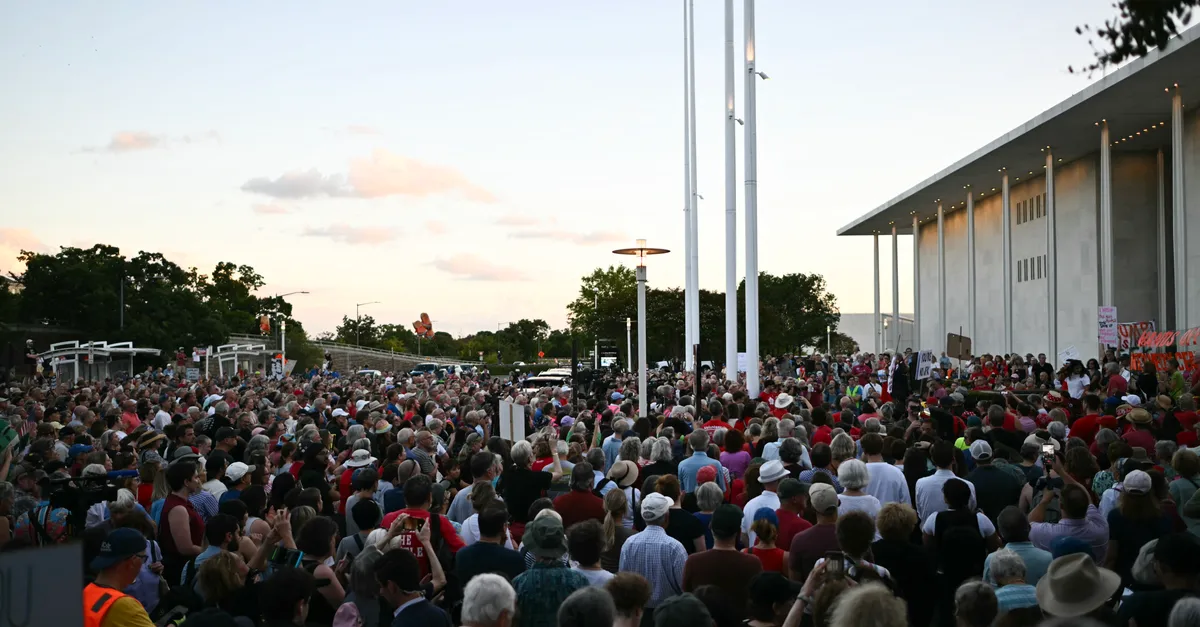
Thousands protested Friday at the Kennedy Center in Washington, D.C., expressing concern that President Donald Trump might demolish the performing arts center as part of a planned renovation. The protests followed a judge’s ruling against the reinstatement of Trump’s name on the building and a subsequent vote by the Kennedy Center board to temporarily close the facility for repairs. Trump has publicly criticized the building’s condition, stating it was in a “virtual state of collapse” after a piece of the ceiling fell, and has linked any reconstruction to a favorable ruling on the naming dispute.
The Kennedy Center board voted Tuesday to close the center indefinitely for repairs hours after U.S. District Judge Christopher Cooper blocked their plans to return Trump’s name to the building. Judge Cooper subsequently ordered the Kennedy Center to provide 30 days’ notice before making any major physical changes, including demolition. Protesters, including members of the Hands Off the Arts organization, fear Trump may bypass this requirement, citing a similar incident at the East Wing of the White House. Chris Raleigh, co-founder of Hands Off the Arts, stated he hoped the event would show people are willing to fight to keep Trump’s plans for the building at bay.
Breitbart News reported the Kennedy Center was recently shut down due to safety concerns, and that a legal filing by the Trump administration described the center as “structurally unsound, fundamentally unsafe, and embarrassing to the Nation’s Capital.” Trump, in a Truth Social post, stated $17 million raised by him has been put into The Kennedy Center account to keep it afloat. Protesters highlighted the importance of the center to the arts community, with Bud Wilkinson setting up a chalkboard where people could erase Trump’s name and replace it with hearts. Alina Baciu spoke about the impact the closure could have on students at the Duke Ellington School of the Arts.
Rep. Don Beyer (D-VA) spoke at the gathering, questioning Trump’s motives for threatening demolition if his name wasn’t restored. Left outlets emphasized the potential for censorship of performances and programming, while right-leaning coverage focused on the building’s disrepair and Trump’s financial contribution. Not in dispute is the Kennedy Center’s temporary closure and the legal battle over its name and future renovation.
Our reading is that the protests at the Kennedy Center represent a confluence of concerns: potential censorship, distrust of President Trump’s motives, and a broader defense of the arts. The differing coverage, focusing on either safety or censorship, highlights how the same event can be framed to appeal to different audiences. The linkage between the naming dispute and the proposed renovation suggests a transactional approach to cultural institutions.
Read the original coverage
💬 Comments
📜 Comment Policy