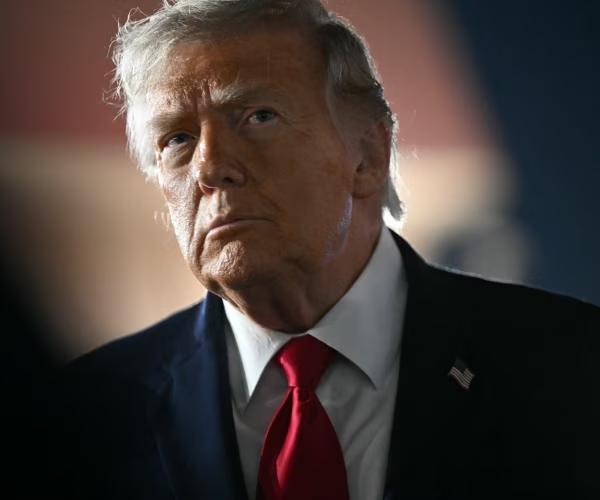
President Donald Trump has publicly refuted reports suggesting that the United States is preparing to make financial payments to Iran as part of a ceasefire agreement. The denial was issued via a social media post released on Monday, in which the President characterized the claims regarding these payments as "fake news." This statement serves as a direct rebuttal to circulating narratives about potential financial components within diplomatic or military ceasefires involving the Islamic Republic.
The controversy stems from recent reports indicating that a ceasefire deal might include monetary transfers from Washington to Tehran. These allegations have drawn significant attention due to the historically tense relationship between the two nations and the strict sanctions regimes previously enforced by the U.S. government against Iran. By labeling the reports as "fake news," President Trump aimed to dismiss the validity of these financial claims entirely, asserting that no such payments are being made or planned under any current agreement.
The incident highlights the ongoing information war surrounding U.S. foreign policy in the Middle East. Reports of financial exchanges often spark intense debate among political observers and international analysts regarding the implications for regional stability and diplomatic leverage. The President's use of the term "fake news" is consistent with his previous rhetorical strategies to discredit media narratives he deems inaccurate or politically motivated. This specific denial addresses the core factual claim of monetary transfer, rather than the broader geopolitical context of the ceasefire itself.
Observers note that such denials are critical in shaping public perception of diplomatic negotiations. When financial terms are alleged in peace deals, they often become focal points for political criticism and scrutiny. By explicitly denying the existence of these payments, the administration seeks to prevent further escalation of domestic political debate or international speculation regarding U.S. concessions to Iran. The President's post did not provide additional details on the nature of the ceasefire or other terms involved, focusing solely on the rejection of the financial aspect.
The response from the White House and the President's office underscores the administration's stance against what it perceives as misinformation regarding its foreign policy actions. While the existence of a ceasefire agreement may be subject to separate verification, the specific claim of U.S. payments remains contested by the highest office in the land. This denial is expected to influence subsequent reporting and analysis from both domestic and international media outlets covering Middle Eastern diplomacy.
As the situation develops, attention remains on whether further clarification will be provided regarding the terms of any ongoing negotiations. The President's firm rejection of the payment narrative sets a clear official position for the U.S. government. It remains to be seen if independent verification or subsequent diplomatic disclosures will confirm or contradict other aspects of the reported ceasefire arrangements. For now, the primary factual record reflects the President's assertion that no such payments are part of the current agreement.
Read the original coverage
💬 Comments
📜 Comment Policy