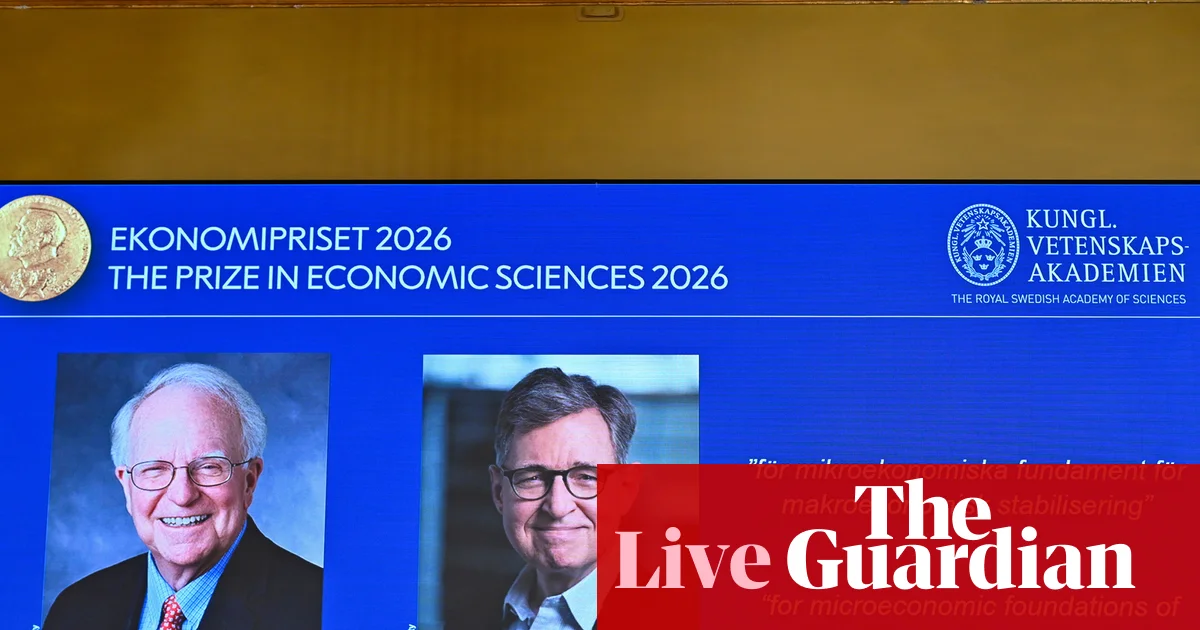
Nobel Economics Prize Awarded to Hall and Woodford for Macroeconomic Stabilization Models
Business
✓ Neutralized●●●
1h ago

Nobel Economics Prize Awarded to Hall and Woodford for Macroeconomic Stabilization Models

AI-synthesized · Bias removed · Facts only
3 sources: 1 left · 1 center · 1 right
Image: Guardian Us

Robert E. Hall and Michael Woodford have been awarded the 2026 Nobel Prize in Economic Sciences for their work developing the microeconomic foundations of macroeconomic stabilization. The Royal Swedish Academy of Sciences recognized their contributions for improving the ability of central banks and governments to manage economic fluctuations, such as those caused by energy crises or shifts in consumer behavior. Their models move beyond simply observing macroeconomic variables like inflation and consumption, instead focusing on how the collective decisions of individual households and businesses impact the economy. The prize, worth 12 million Swedish kronor (approximately $1.2 million), acknowledges research that has fundamentally shaped modern economic thinking and informed policy decisions worldwide.

Analysts at Clarivate, who previously identified both Hall and Woodford as potential Nobel laureates, highlighted the enduring impact of their research, noting its influence on generations of economists. Costas Milas, an economics professor at the University of Liverpool, suggested Woodford’s work holds lessons for current UK policymakers as they navigate the unwinding of stimulus measures implemented since the financial crisis, advocating for scenario testing in quantitative tightening policies. The academy stated that these models allow for well-timed fiscal and monetary policies to reduce economic peaks and troughs, proving extremely helpful in addressing recent economic downturns. The Sveriges Riksbank Prize in Economic Sciences, established in 1968, differs from the original Nobel Prizes, but is presented alongside them on December 10th, the anniversary of Alfred Nobel’s death. While the majority of past recipients have been from the United States, only three women have ever received the award, most recently Claudia Goldin in 2023.

Where they differ

  • The New York Post emphasized the surprise expressed by Woodford upon receiving the news, quoting his statement: “It’s a tremendous honor, it’s a surprise.”
  • France24, in both its reports, presented the information as a straightforward announcement of the prize award, focusing on the nationality of the winners.
  • The Straits Times highlighted that the prize is equivalent to S$1.54 million, providing a currency conversion for a Singaporean audience.
  • The Hindu provided context on previous winners, noting the 2025 prize went to researchers studying business innovation and the 2023 prize to Claudia Goldin for work on gender and pay.

What is not yet known

  • The specific details of the models developed by Hall and Woodford are not detailed within the sources.
  • The extent to which these models are currently being used by central banks and governments beyond general statements of their influence remains unclear.

Background

  • The Sveriges Riksbank Prize in Economic Sciences, commonly known as the Nobel Prize in Economic Sciences, was established in 1968 and is awarded alongside the original Nobel Prizes on December 10th [Fact Refinery, 2026-10-07].
  • In 2023, Claudia Goldin received the Nobel Prize in Economic Sciences for her research on gender and pay [Fact Refinery, 2026-10-07].
  • In 2025, the prize was awarded to researchers focusing on business innovation [Fact Refinery, 2026-10-07].
  • Molecules can exist as mirror images of each other, a phenomenon known as chirality, which has been a longstanding puzzle in chemistry [Fact Refinery, 2026-10-07].

Our reading

Our reading is that the 2026 Nobel Prize in Economic Sciences recognizes research with practical implications for economic policy, specifically in stabilizing economies during fluctuations. The award highlights the shift in macroeconomic modeling towards understanding individual behavior as a driver of broader economic trends. The reporting suggests a degree of surprise among the recipients and a focus on the nationality of the winners by some outlets, while others emphasize the monetary value of the prize for different audiences.

What to watch

  • The UK’s autumn Budget on October 28th, to see if policymakers incorporate scenario testing in quantitative tightening policies, as suggested by Professor Milas [Fact Refinery, 2026-09-22].
  • Whether central banks and governments publicly detail how they are utilizing Hall and Woodford’s models in their economic forecasting and policy decisions, beyond general statements of influence [sources].
  • Official statements from the Royal Swedish Academy of Sciences detailing the specifics of the models developed by Hall and Woodford [sources].
Was this useful?

Read the original coverage

💬 Comments

📜 Comment Policy