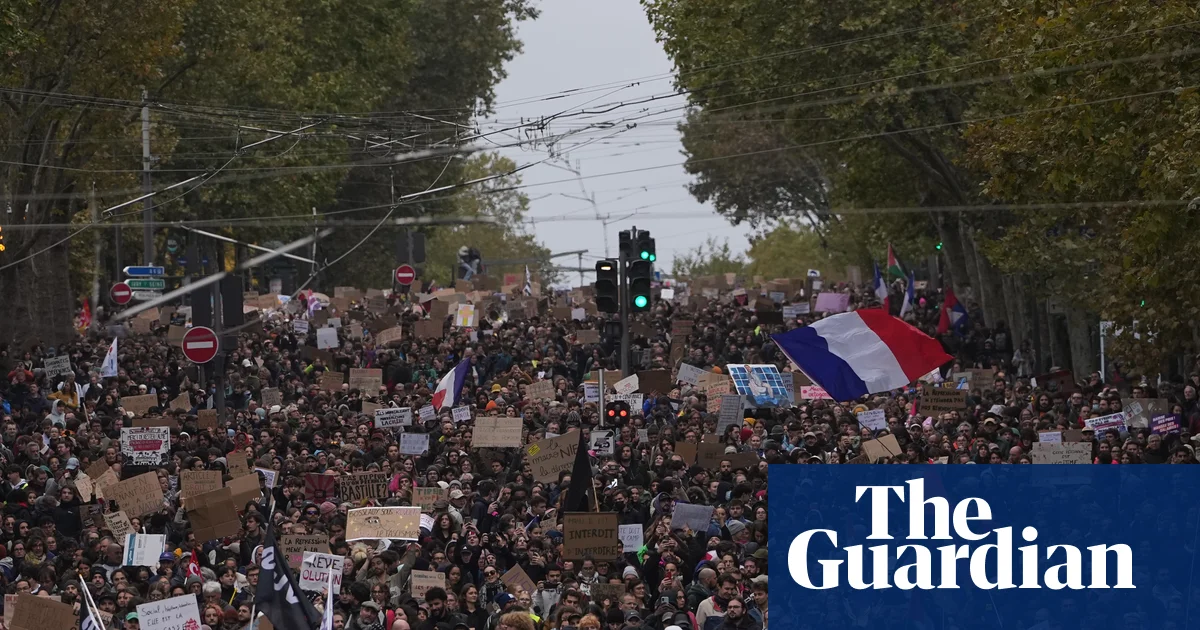
Hundreds of thousands of people marched in cities across France on Saturday, protesting issues ranging from school conditions and policing to the rising cost of living. Government estimates placed the number of protesters at 410,000, while labor unions claimed participation reached 800,000. The protests, largely peaceful, saw clashes erupt in several cities, including Paris, Marseille, and Lyon, with police deploying tear gas, water cannons, and stun grenades. At least two people were seriously injured, and nearly 1,000 arrests were made nationwide.
The demonstrations were initially sparked by concerns from high school students regarding a lack of resources and repairs in schools. However, the protests broadened to encompass wider grievances, including the high cost of living and perceived heavy-handed policing tactics. Protesters carried signs criticizing the government’s policies and police actions, with some chanting slogans against the state. In Paris, the march began peacefully with brass bands and families participating, but ended with confrontations between masked individuals and police, who responded with force. Interior Minister Laurent Nuñez stated that “high-risk groups” broke away from the main body of protesters to commit acts of violence, and that many of those arrested were carrying weapons, including fireworks, slingshots, and even rifles.
The government had deployed over 70,000 police officers and closed museums and businesses in anticipation of unrest, fearing a repeat of violent demonstrations from the previous week. The government also banned non-union demonstrations and restricted protesters to specific areas, drawing criticism from participants. One protester in Paris, Nadège, stated she had been teargassed at a peaceful demonstration the previous week and was participating to support others. Another protester expressed frustration with the difficulty of finding work and the need to take on precarious employment. The Louvre, Musée d’Orsay, and other cultural institutions were closed as a precaution, and security forces barricaded approaches to the Élysée Palace and Arc de Triomphe.
While the protests were widespread, the extent of the violence and the motivations of those involved remain a point of contention. The government attributes the clashes to far-left activists and criminal gangs, while protesters claim they were provoked by police actions. The protests occurred as President Emmanuel Macron faces a social and political crisis in his final months in office.
Our reading is that the protests represent a confluence of localized grievances, specifically, concerns about schools, and broader national anxieties regarding economic hardship and policing. The government’s response, characterized by bans and heavy police deployment, appears to be escalating tensions rather than addressing the underlying issues, as evidenced by the continued clashes and the differing accounts of who is instigating the violence. The framing of the protests by different media outlets suggests a contested narrative, with some emphasizing the presence of weapons and far-left influence while others focus on the initial concerns of students and broader economic frustrations.
Read the original coverage
💬 Comments
📜 Comment Policy