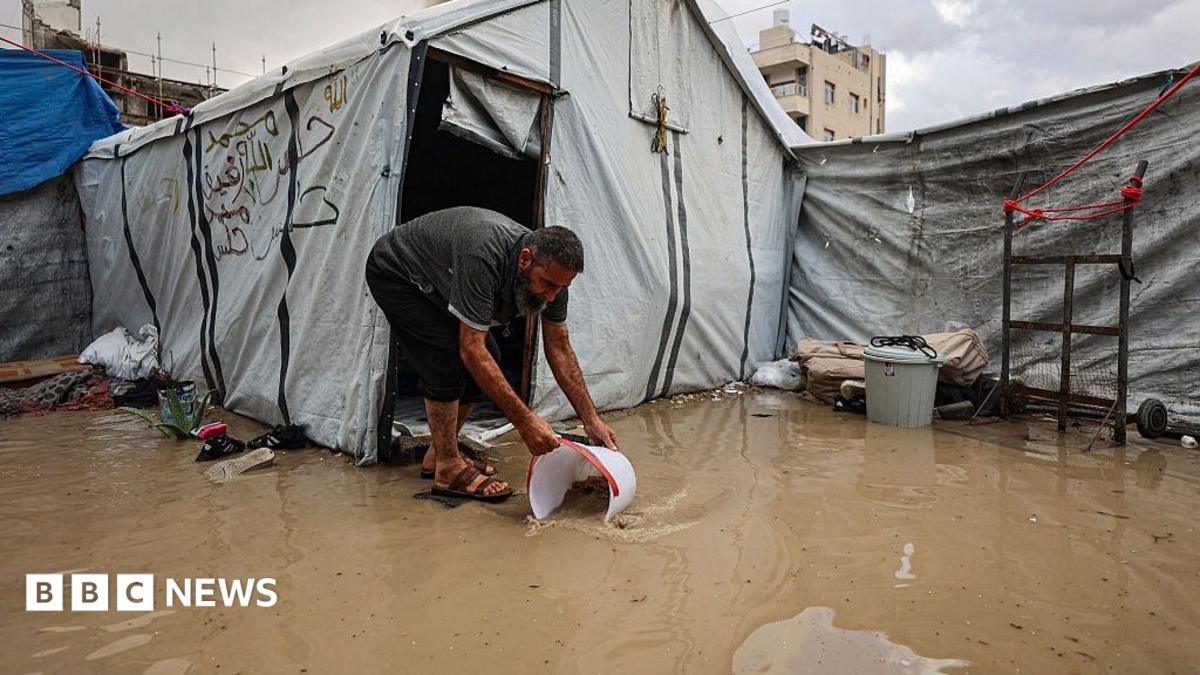
Heavy rains have flooded approximately 70,000 tents sheltering displaced people in Gaza, causing injuries from collapsing structures and raising fears of disease. The Hamas-run government in Gaza reports widespread flooding and some critical injuries, while aid organizations warn of a worsening situation due to limited resources and restrictions on access. Jonathan Veitch, the Unicef representative for Palestine, stated that “nearly everyone” in Gaza needs assistance, and aid workers are being “stopped on the street” by desperate residents. The flooding occurs after two years of conflict triggered by the October 7, 2023, Hamas attack on Israel, and despite a ceasefire agreement reached in October 2025, Israeli airstrikes continue. Mustafa Qazzaat, a member of the Gaza city council, said Israel has not allowed prefabricated homes to shelter the displaced since the truce, and only permits limited numbers of tents. The situation is exacerbated by UN budget cuts, reducing the availability of essential supplies like tarpaulins. Um Muhammad al-Hersh, 45, described the loss of belongings, and Maryam Odeh, 34, expressed fear for her children’s safety. Civil defense teams report receiving over 1,500 calls for assistance, but are operating with limited equipment. The coalition of Palestinian civil society organizations is calling for international pressure on Israel to allow unrestricted humanitarian aid.
Since the ceasefire, 1,580 people have been killed in Gaza, according to the Hamas-run health ministry, whose figures are considered reliable by the UN. Israel maintains it is targeting Hamas, but civilians are often killed in the process. The need for 200,000 prefabricated homes has been urgently stated, alongside a need for heavy machinery to clear rubble.
Our reading is that the current flooding in Gaza is not simply a natural disaster, but a crisis dramatically worsened by ongoing conflict and political obstruction. The reports highlight a clear disconnect between the scale of need, nearly everyone requiring assistance, and the ability of aid organizations to respond, due to both resource limitations and deliberate restrictions on access. The specific detail of prefabricated homes being blocked, alongside UN budget cuts, suggests a systemic failure to provide adequate shelter for the displaced population.
Read the original coverage
💬 Comments
📜 Comment Policy