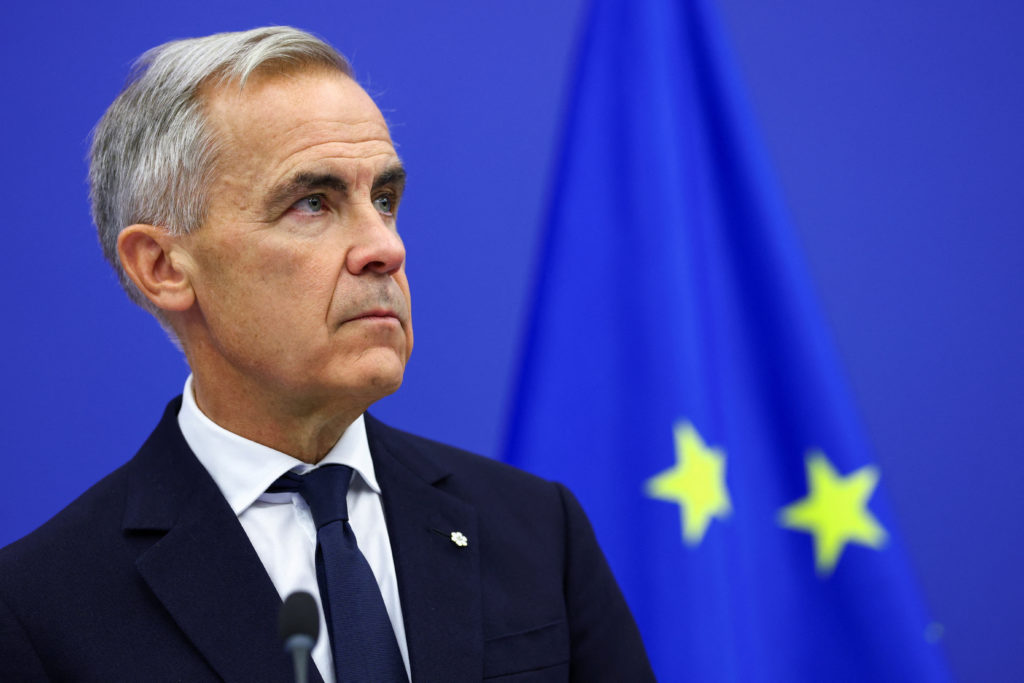
Carney Proposes Canada-EU Associate Membership as US Raises Trade Concerns
Politics
✓ Neutralized
1h ago

Carney Proposes Canada-EU Associate Membership as US Raises Trade Concerns

AI-synthesized · Bias removed · Facts only
3 sources: 1 left · 2 center · 0 right
Image: Pbs Newshour

Canadian Prime Minister Mark Carney on Thursday welcomed a proposal for Canada to become the first associate member of the European Union, framing the alliance as a means to bolster economic resilience and sovereignty. The proposal comes amid increasing concerns about the weaponization of economic tools and follows recent tariff increases imposed by the United States on Canadian goods. Carney, speaking to EU lawmakers, emphasized that the goal is not to create a new power bloc but to ensure no single country can exert undue control over Canada’s markets. The European Commission President Ursula von der Leyen voiced support for the initiative, while former German Chancellor Friedrich Merz previously advocated for a similar arrangement with Ukraine.

President Donald Trump responded to the proposal by calling it “laughable” and threatening tariffs on the EU if the move is perceived as “hostile.” He described Canada as a “terrible trade partner” and suggested the US could halt trade with Europe. Carney, in his address, alluded to these pressures, stating that economic integration is being “weaponized” through tariffs and financial coercion. He highlighted the need for strategic autonomy in areas such as critical minerals, defense, AI, and energy security.

While associate membership is not currently a formal category within EU treaties, Von der Leyen signaled a willingness to explore the arrangement with Canada. Carney sought to differentiate the proposed alliance from a pursuit of great power status, stating the aim is resilience “so no one can control our open markets, impair our sovereignty.” He also outlined areas for increased cooperation, including digital trade and transatlantic student/worker exchanges. The EU Commission clarified that the proposal is intended to strengthen ties, not to act against any other nation.

Where they differ

  • Right-leaning outlets (Newsmax, Washington Times) focused on Carney’s embrace of the proposal and the potential for trade conflict with the US, emphasizing Trump’s reaction.
  • Left-leaning sources (PBS Newshour, Al Jazeera) highlighted Carney’s emphasis on resilience and sovereignty, framing the move as a response to economic coercion.
  • Center sources (CNBC, The Hill, Japan Times) presented a more balanced overview, detailing both the proposal itself and the US response.
  • Al Jazeera and Japan Times provided additional context on Carney’s broader vision for cooperation, including specific areas like AI and energy security.

What is not yet known

  • The specific details of what “associate membership” would entail remain undefined, as it is not a formal category under EU treaties and requires ratification by member states.
  • The extent to which the EU member states will support the proposal is not yet clear.
  • The precise nature of any potential tariffs the US might impose on Europe remains unspecified.

Background

  • Mark Carney is the current Prime Minister of Canada, actively promoting investment and navigating trade disputes with the United States [Fact Refinery, 2026-09-14].
  • The United States, under President Donald Trump, has recently imposed escalating tariffs and bans on Canadian goods, leading to retaliatory measures from Canada [Fact Refinery, 2026-09-08].
  • The European Union proposed a new “associate member” status for Canada, a first-of-its-kind relationship intended to strengthen ties amid shifting global dynamics [Fact Refinery, 2026-09-17].
  • Canada has been diversifying its defense ties, formally applying to join the British-led Joint Expeditionary Force military coalition [Fact Refinery, 2026-09-17].

Our reading

Our reading is that Canada, facing sustained economic pressure from the US, is proactively seeking alternative alliances to bolster its economic resilience and sovereignty. The proposal for EU associate membership appears to be a strategic move to lessen dependence on the US market and create a counterweight to potential economic coercion. The differing media coverage highlights the political sensitivities surrounding this initiative, with right-leaning outlets focusing on potential conflict and left-leaning sources emphasizing Canada’s pursuit of autonomy.

What to watch

  • Ratification by EU member states of the proposed “associate membership” arrangement with Canada [EU Commission website].
  • Any specific tariffs announced by the US in response to the EU-Canada proposal, and the timeframe for their implementation [US Trade Representative website].
  • The release of detailed specifics regarding what “associate membership” would entail, including areas of cooperation beyond those already mentioned [European Commission website].
Was this useful?

Read the original coverage

💬 Comments

📜 Comment Policy