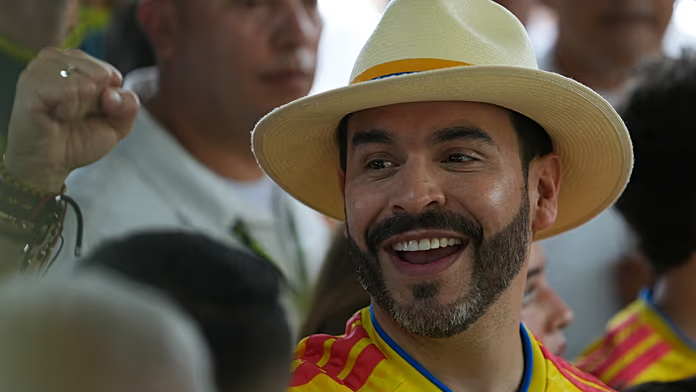
Colombian conservative candidate Abelardo de la Espriella has been elected as the next president of Colombia, defeating far-left Senator Iván Cepeda in the presidential runoff election held on Sunday. The result marks a significant shift in the country's political landscape, with De la Espriella securing a narrow victory over his opponent. This outcome places a self-styled outsider at the helm of the South American nation, ending the tenure of the previous administration and setting the stage for new policy directions under a leader who has positioned himself against traditional political establishments.
The election results have drawn immediate attention from international observers and political figures across the region. Former U.S. President Donald Trump and U.S. Senator Marco Rubio, who represents Florida, both issued congratulations to De la Espriella regarding his preliminary victory. These messages of support highlight the growing diplomatic ties between Colombia and the United States under the incoming administration. The congratulatory notes from high-profile American political figures underscore the geopolitical significance of this election, particularly given De la Espriella's alignment with conservative values that resonate with certain factions within the U.S. Republican Party.
Conservative leaders throughout Latin America also celebrated the results of the presidential election. The victory is viewed by many regional conservatives as a potential turning point for right-wing politics in South America. De la Espriella’s win gives a razor-thin advantage to the outsider candidate, reflecting a fragmented electorate and a close contest that hinged on specific demographic shifts and voter turnout in key regions. The narrow margin of victory suggests that while De la Espriella has won, his mandate may be subject to intense scrutiny and political maneuvering in the days leading up to his inauguration.
Background information on Abelardo de la Espriella reveals a political trajectory distinct from traditional career politicians. According to reports, De la Espriella created his political movement just 11 months ago. This rapid rise mirrors models of political success observed in other countries, specifically Argentina and El Salvador. In those nations, outsider candidates utilized patriotic rhetoric, a firm stance against crime, and a demonstrated contempt for traditional political processes to gain power. De la Espriella’s campaign strategy appears to have adopted similar tactics, focusing on nationalistic themes and law-and-order policies to appeal to voters disillusioned with the status quo.
Prior to his election, De la Espriella was known primarily as a controversial lawyer rather than a seasoned politician. His background in law has informed his political platform, which emphasizes strict legal enforcement and structural changes to the judiciary. Critics and supporters alike have noted his sharp criticism of existing political institutions, framing them as ineffective or corrupt. This narrative has resonated with voters seeking change, contributing to his success in the runoff election.
As De la Espriella prepares to assume office, the focus shifts to how he will implement his promised reforms. The transition period will be critical in determining whether his outsider status translates into effective governance or if it leads to political instability. International partners, including the United States and various Latin American governments, are closely monitoring the situation to assess the implications for regional stability and trade relations. The incoming administration faces immediate challenges in addressing crime rates, economic concerns, and diplomatic relations, all while managing the expectations of a diverse electorate that supported his narrow victory.
Read the original coverage
💬 Comments
📜 Comment Policy