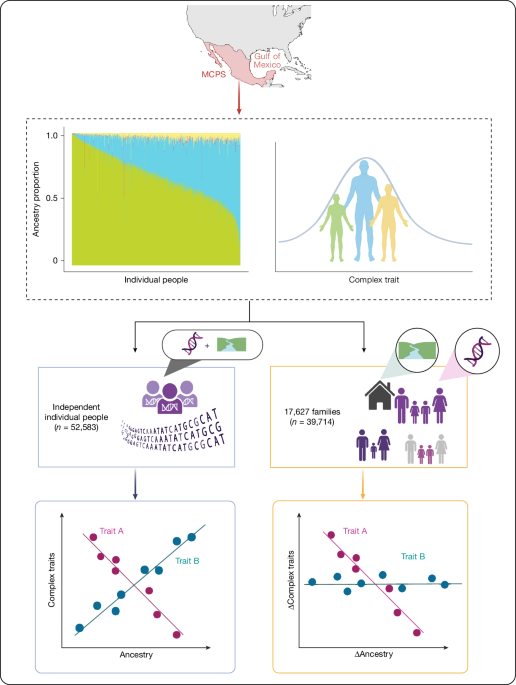
A study conducted by researchers analyzing data from the Mexico City Prospective Study has revealed significant within-family effects of Indigenous American ancestry on height and type 2 diabetes. The research, leveraging genetic data from over 52,000 individuals, aimed to determine the extent to which genetic factors contribute to phenotypic differences between populations, while controlling for environmental influences.
The study examined 52,583 unrelated individuals and 39,714 relatives from 17,627 families. Researchers found that, at the population level, Indigenous American ancestry was associated with a height reduction of −1.98 standard deviations (s.d.) (P < 2 × 10⁻¹⁶) and a 1.73 natural log odds ratio for type 2 diabetes (95% confidence interval, 1.54-1.92). Importantly, within families, the effect of Indigenous American ancestry remained significant, showing a height reduction of −1.51 s.d. (P = 10−8) and a substantially increased risk of type 2 diabetes, with a natural log odds ratio of 5.13 (95% confidence interval, 2.48-7.78).
These findings are supported by observations of differences in the number of trait-increasing alleles between ancestries and evidence of selection at genetic loci associated with these traits. Researchers noted that no within-family ancestry effect was observed for educational attainment or other traits, suggesting environmental factors or confounding variables may be at play. The study highlights the importance of considering both genetic and environmental influences when examining population differences in complex traits and diseases. The researchers state that the study provides a design for studying between-ancestry genetic effects and identifies significant ancestry differences for height, type 2 diabetes and metabolic traits in a genetically diverse population from Mexico City.
閱讀原始報道
💬 评论
📜 评论政策