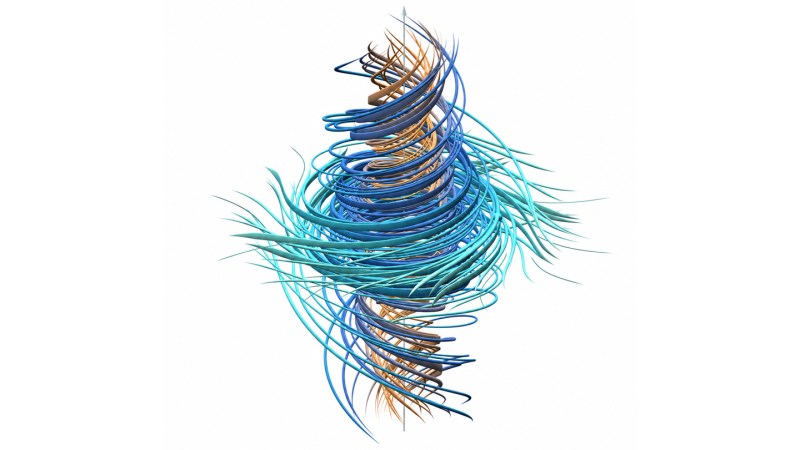
OpenAI announced a potential solution to the Navier–Stokes existence and smoothness problem, a major challenge in mathematics with a $1 million prize. The announcement follows related work by Tristan Buckmaster and Levent Alpöge, who used AI assistance to make an advance on a closely related problem. The findings address whether the equations governing fluid motion are always ‘well-behaved’ and don’t produce impossible scenarios.
The Navier–Stokes equations, dating to the 19th century, describe the relationships between pressure, density, and velocity of fluids, and are crucial for fields like weather forecasting and aircraft design. Despite their importance, mathematicians have long debated whether the equations always produce realistic results or if they can ‘break down’ under certain conditions, creating physically impossible situations like infinite fluid speed, known as “blowups.” This question is one of seven Millennium Prize Problems established by the Clay Mathematics Institute in 2000, each carrying a $1 million reward.
Tristan Buckmaster of New York University and Levent Alpöge of Anthropic recently solved the “forced Euler problem,” a related challenge involving equations that don’t include viscosity. Their work, completed with the help of AI models, preceded OpenAI’s announcement. OpenAI researchers then used approximately 10,000 AI agents to tackle the Navier-Stokes problem, ultimately discovering a solution to the forced version: a vortex that accelerates infinitely. This confirms that the Navier-Stokes equations are not always well-behaved. The research cost millions of dollars, according to OpenAI.
“It’s one of the guiding problems for the field. It is a huge deal to know the answer,” said mathematician Dallas Albritton of the University of Wisconsin–Madison, who was not involved in the research. OpenAI stated in a blog post that they will not claim the $1 million prize.
मूल कवरेज पढ़ें
💬 टिप्पणियाँ
📜 टिप्पणी नीति