U.S. Issues Security Alerts Across Middle East Amid Escalating Tensions
Politics
✓ Neutralized
2h ago

U.S. Issues Security Alerts Across Middle East Amid Escalating Tensions

AI-synthesized · Bias removed · Facts only
3 sources: 1 left · 1 center · 1 right
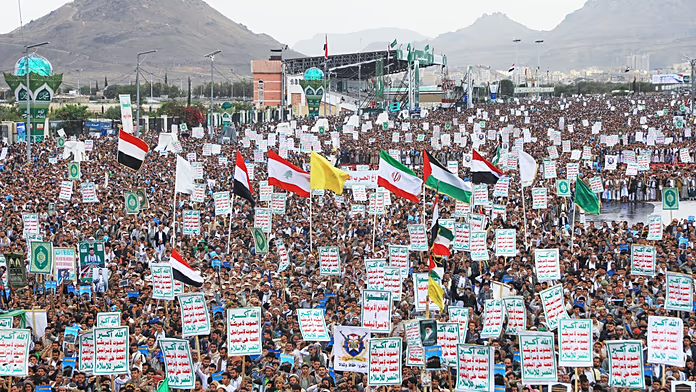
Image: Euronews

U.S. embassies across the Middle East have issued security alerts to Americans following increased attacks by Yemen’s Houthi rebels on Saudi Arabia, including a missile targeting Riyadh and strikes on oil facilities. The U.S. military has escorted one billion barrels of oil and over 2,000 commercial vessels out of the Persian Gulf in the last two months. The Houthis have expanded attacks, declaring a naval blockade of Saudi Arabia and targeting infrastructure deep within the country, while Iran has reportedly conveyed conditions for reopening the Strait of Hormuz, including an end to the war, release of frozen funds, and an end to the naval blockade. President Trump indicated a potential “big decision” regarding a major assault on Iran, and convened a meeting with Persian Gulf leaders. Egypt, Jordan, and Kuwait condemned the Houthi attack on Riyadh, citing a threat to regional security.

The conflict has escalated since August, with the UN Human Rights office documenting 110 civilian casualties in Yemen across Taizz, Al Hudaydah, and Marib. The situation remains complex, with potential for rapid escalation and disruptions to travel and airspace. Qatar is acting as a mediator between Iran and the U.S., conveying conditions for de-escalation. Saudi Arabia intercepted a ballistic missile aimed at Riyadh and reported attacks on multiple cities, while residents of the capital reported seeing smoke at King Khalid International Airport. The Houthis have seized territory in western Yemen, including the port city of Mokha and Perim Island, a key shipping chokepoint. Saudi Arabia recently suspended operations on its East-West oil pipeline after a drone attack it blamed on Iran-backed militias in Iraq.

Where they differ

  • RT emphasized potential U.S. strikes on Iran and Houthi targets, citing sources indicating Trump was reviewing strike options.
  • Euronews highlighted the UN’s reporting of civilian casualties in Yemen, providing specific numbers and a quote from a UN spokesperson.
  • CBS News focused on the volume of oil and commercial vessels escorted by the U.S. military through the Persian Gulf, and Iran’s conditions for reopening the Strait of Hormuz.

What is not yet known

  • Whether the U.S. will respond to the attacks with military action remains unresolved.
  • The extent to which Iran is directing or supporting the Houthi attacks is not definitively established.
  • Whether negotiations to reopen the Strait of Hormuz will succeed is currently uncertain.

Background

  • Yemen has been experiencing escalating conflict, with Houthi rebels seizing territory including Mokha and Perim Island, a key shipping chokepoint [Fact Refinery, 2026-09-20].
  • The U.S. military has been actively escorting commercial vessels and oil through the Persian Gulf, having moved one billion barrels of oil and over 2,000 vessels in the last two months [Fact Refinery, 2026-09-18].
  • Iran and the U.S. have been engaged in a period of heightened tension, with the U.S. imposing sanctions on Iran and Iran conveying conditions for reopening the Strait of Hormuz [Fact Refinery, 2026-09-18].
  • The Bab el-Mandeb Strait is a strategically important maritime chokepoint, with approximately 125,000 people displaced due to fighting along Yemen’s Red Sea coast [Fact Refinery, 2026-09-18].

Our reading

Our reading is that the situation in the Middle East is rapidly deteriorating, with multiple actors escalating their actions and increasing the risk of wider conflict. The combination of Houthi attacks, Iran’s stated conditions, and the U.S.’s military presence suggests a complex interplay of power dynamics and potential for miscalculation. The differing emphases of the cited news outlets, on potential U.S. strikes, civilian casualties, and logistical movements, highlights the multifaceted nature of the crisis.

What to watch

  • A vote by the U.S. Congress on any proposed military action against Iran or Houthi targets [U.S. Congressional records].
  • The deadline for Iran to respond to Qatar’s mediation efforts regarding the Strait of Hormuz, if one exists [Qatari Ministry of Foreign Affairs statements].
  • Any changes in oil prices or shipping traffic through the Strait of Hormuz and Bab el-Mandeb Strait [Bloomberg, Lloyd’s List].
Was this useful?

Read the original coverage

💬 Comments

📜 Comment Policy