US Economists Win Nobel for Models Analyzing Economic Shock Responses
Business
✓ Neutralized●○●
2h ago

US Economists Win Nobel for Models Analyzing Economic Shock Responses

AI-synthesized · Bias removed · Facts only
3 sources: 2 left · 0 center · 1 right
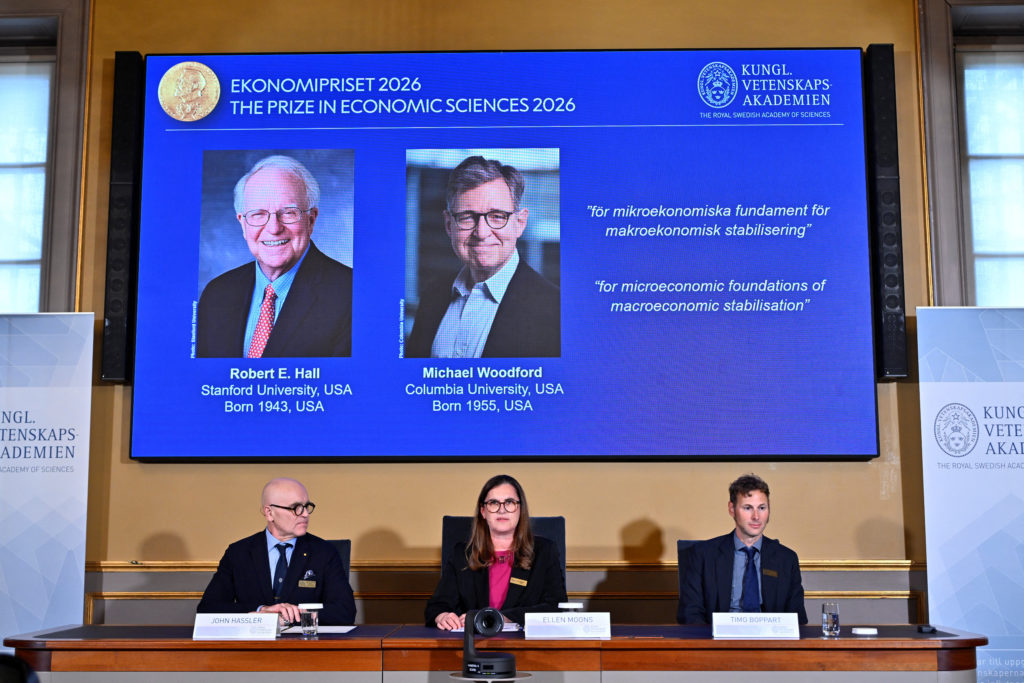
Image: Pbs Newshour

Robert E. Hall and Michael Woodford have been awarded the 2026 Nobel Memorial Prize in Economic Sciences for their work on models that incorporate microeconomic factors into macroeconomic stabilization policies. The Royal Swedish Academy of Sciences announced the prize Monday, citing the economists’ contributions to understanding how governments and central banks can better manage economic shocks, such as energy crises and inflation. Their work challenged traditional Keynesian models, which the academy said demonstrated limitations in curbing unemployment and controlling inflation during the 1970s. Hall, affiliated with Stanford University, and Woodford, of Columbia University, focused on how individual household and business decisions impact the broader economy.

The academy stated the laureates’ models provide a “stable theoretical foundation” for the tools used by central banks and governments worldwide, allowing them to better respond to economic crises. A central component of their models is the recognition that households and businesses are forward-looking when making decisions. By communicating their economic policies clearly, governments and central banks can influence these expectations, impacting savings and pricing.

Recent Federal Reserve policy, under both Jerome Powell and Kevin Warsh, has shown a reluctance to rely on predictive models, instead prioritizing real-time economic cues. This approach aligns with the thinking of economists like Milton Friedman, who gained prominence after the stagflation of the 1970s. During and after the COVID-19 pandemic, with global economies facing high inflation, the role of central banks has again come to the forefront. The Nobel committee highlighted that Hall and Woodford’s work improved upon Keynes’s model by focusing on micro-level factors. However, the extent to which current central bank messaging aligns with the laureates’ models, and whether a shift towards clearer future predictions will occur, remains an open question, given recent economic turmoil.

Where they differ

  • The Washington Examiner emphasized that the models developed by Hall and Woodford challenge Federal Reserve policies in recent years, and noted Kevin Warsh’s advocacy for less government intervention.
  • DW highlighted the limitations of Keynesian models, stating they failed to curb unemployment and instead raised inflation during the 1970s.
  • PBS Newshour presented the award announcement as a straightforward report of the Nobel Prize being awarded for work on managing economic shocks.

What is not yet known

  • Whether current Federal Reserve policy will shift towards clearer future predictions, as suggested by the laureates’ models.
  • The degree to which the models are actually used in practice by central banks and governments, beyond providing a 'theoretical foundation'.

Background

  • The Nobel Memorial Prize in Economic Sciences is awarded annually by the Royal Swedish Academy of Sciences to individuals who have made outstanding contributions to the field of economics [Fact Refinery, 2026-10-12].
  • Robert E. Hall and Michael Woodford developed models focusing on how individual economic decisions impact the broader economy, moving beyond traditional macroeconomic variables [Fact Refinery, 2026-10-12].
  • Keynesian economic models, dominant for a period, were found to have limitations in addressing unemployment and inflation during the 1970s [background knowledge].
  • Milton Friedman gained prominence advocating for policies differing from Keynesian approaches following the stagflation of the 1970s [background knowledge].
  • Recent Federal Reserve policy, under both Jerome Powell and Kevin Warsh, has shown a preference for real-time economic cues over predictive models [Fact Refinery, 2026-10-12].

Our reading

Our reading is that the Nobel Prize recognizes a theoretical framework that challenges some recent approaches to economic management. The award highlights a tension between relying on models to predict economic behavior and prioritizing immediate data, a debate currently playing out within the Federal Reserve. While the models are presented as a “stable theoretical foundation,” the article acknowledges uncertainty about their practical application, given recent economic instability and the current Fed’s approach.

What to watch

  • Whether the Federal Reserve publicly incorporates forward-looking communication into its policy statements, as suggested by Hall and Woodford’s models [article: “What is not yet known”].
  • Data on the extent to which central banks and governments globally are utilizing the laureates’ models in their economic forecasting and policy decisions [article: “What is not yet known”].
  • Any statements from current Federal Reserve leadership, specifically Jerome Powell or Kevin Warsh, regarding a potential shift in their approach to economic modeling [Washington Examiner, DW, PBS Newshour].
Was this useful?

Read the original coverage

💬 Comments

📜 Comment Policy