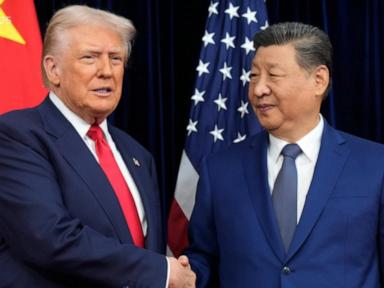
President Donald Trump's meeting with Chinese President Xi Jinping during his trip to China drew attention from analysts who highlighted both the strategic stakes and the risk that Beijing could distort the American leader's words.
ABC News' Linsey Davis interviewed Bonnie Glaser, managing director of the Indo-Pacific Program at the German Marshall Fund, to discuss what to expect from the summit. Glaser, an expert on Chinese foreign policy, provided an assessment of the key issues likely to arise and the strategic calculations on both sides. She discussed the potential for progress on areas of mutual concern as well as the obstacles posed by divergent interests. The interview underscored the significance of direct leader-to-leader engagement in managing the complex U.S.-China relationship.
In a separate perspective piece, Radio Free Asia cautioned that Beijing has a record of misrepresenting statements made by visiting dignitaries to imply support for its repressive policies. The outlet stated that Chinese officials have previously issued readouts or public summaries that selectively quoted or paraphrased foreign leaders, creating a false impression of endorsement. The piece urged vigilance during Trump's visit, warning that China could twist his remarks to serve its own domestic and international narratives. It argued that such manipulation could undermine U.S. messaging and give Beijing an undeserved propaganda victory.
The meeting occurred amid ongoing tensions over trade, technology competition, and military activities in the region. The contrasting perspectives from the two sources illustrated the dual challenges inherent in high-level diplomacy with Beijing: pursuing substantive outcomes while guarding against the exploitation of public statements.
Glaser's analysis, as reported by ABC News, focused on the diplomatic opportunities and risks, emphasizing the need for clear communication and strategic clarity. The Radio Free Asia warning reflected concerns among critics of the Chinese government that diplomatic engagements are often leveraged for propaganda, with Beijing shaping the narrative to suggest foreign support for its policies.
As the visit concluded, attention turned to the official statements released by both governments. Analysts compared the language for any discrepancies that might indicate misrepresentation. The episode highlighted the broader debate over how to approach dialogue with China, balancing the benefits of engagement with the imperative to prevent the distortion of a leader's words.
Read the original coverage
💬 Comments
📜 Comment Policy