Spain Begins National Mourning After Train Crash Kills 68
AI-synthesized · Bias removed · Facts only
3 sources: 3 left · 0 center · 0 right
Facts are sacred. Opinion is labelled.
Image: Bbc Us
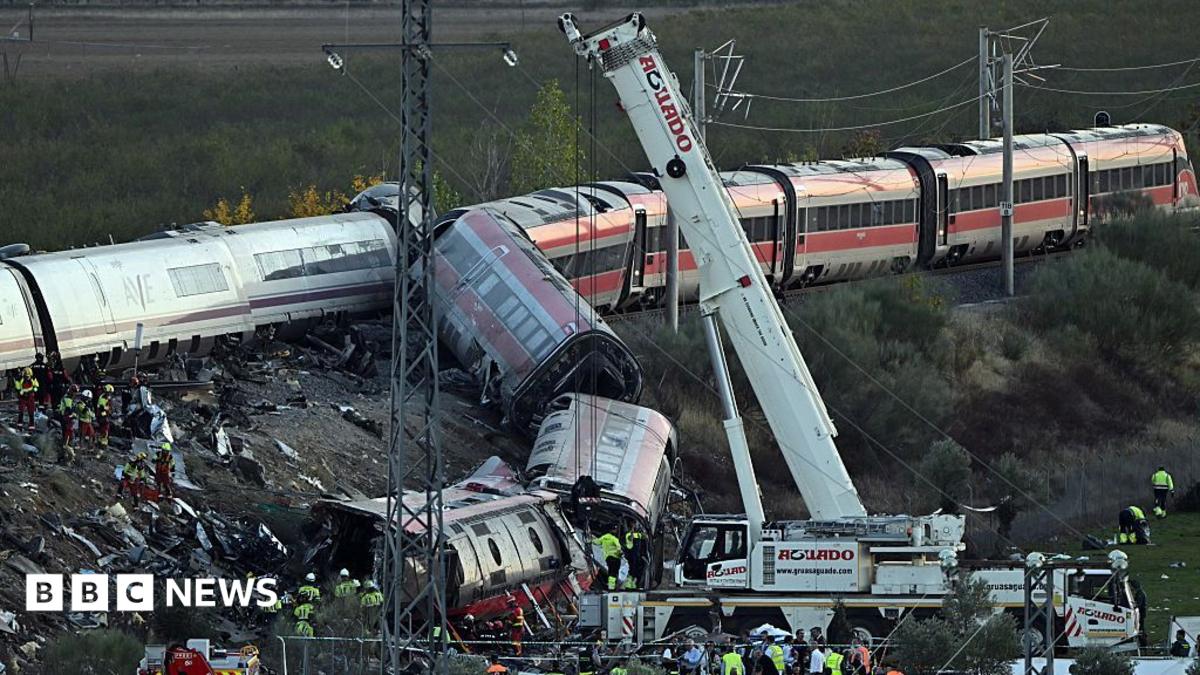
Spain has begun three days of national mourning after a high-speed rail collision in Castilla-La Mancha killed at least 68 people and injured many others. The crash occurred when a Renfe train collided with a stationary Iryo train, which had stopped due to a computer failure. Transport Minister Óscar Puente stated that a decision to resume traffic after the system failure was “inexplicable.”
Emergency services worked through the night to extract victims from the wreckage, with over 1,500 people gathering outside the Transport Ministry in Madrid to demand accountability, leading to clashes with police and tear gas deployment. The crash is the deadliest rail disaster in Spain in over a decade and comes less than nine months after a similar incident on the same line killed 46 people near Córdoba. Most political parties suspended campaigning for upcoming elections, with the exception of the hard-right party Vox, whose leader, Santiago Abascal, opposed halting criticism of the country’s rail infrastructure.
The stationary Iryo train had 147 passengers onboard, while the Renfe train carried 397. Witnesses described scenes of chaos and distress, with passengers trapped and carriages derailed. Relatives are searching for loved ones, and authorities have established centers for DNA identification and support. The incident raises fresh safety concerns about Spain’s rail network, particularly given the recent history of serious accidents on the same line. Audio recordings suggest a high-speed train was given clearance to proceed despite the stalled train ahead.
Where they differ
- BBC News and Channel 4 News emphasized the immediate declaration of three days of national mourning and the Prime Minister's response.
- PBS NewsHour focused on the shock, anger, and mourning within Spain following the crash, framing it as the second fatal rail accident this year.
- The Straits Times provided more detailed accounts from survivors, including specific quotes and descriptions of the scene, and highlighted the Red Cross's efforts to support families.
- The Straits Times reported the incident occurred on October 28th and 29th, while other sources simply stated 'Wednesday'.
What is not yet known
- The precise nature of the “inexplicable” decision made by the control center in Madrid remains unclear.
- The full extent of the computer failure that initially stopped the Iryo train has not been detailed.
Background
- Spain’s high-speed rail network has experienced serious accidents recently; a similar incident near Córdoba killed 46 people less than nine months prior to this crash [Fact Refinery, 2026-10-28].
- The Renfe and Iryo rail companies both operate high-speed trains in Spain, with the Renfe train carrying 397 passengers and the Iryo train carrying 147 in this incident [Fact Refinery, 2026-10-28].
- In 2014, Spain experienced an outbreak of Ebola, resulting in 20 cases, prompting the establishment of a task force to prepare for future outbreaks [Fact Refinery, 2026-10-20].
- High-speed rail networks require complex signalling and control systems to prevent collisions, and computer failures can disrupt these systems [background knowledge].
Our reading
Our reading is that this crash, following a similar incident on the same line less than a year ago, highlights serious and ongoing safety concerns within Spain’s high-speed rail network. The Transport Minister’s description of the decision to resume traffic as “inexplicable” suggests a potential breakdown in safety protocols or communication. The suspension of campaigning by most political parties, contrasted with Vox’s opposition, indicates a widespread acknowledgement of the gravity of the situation, though not universal agreement on appropriate responses.
What to watch
- The results of the investigation into the “inexplicable” decision to resume traffic after the initial computer failure, and any resulting personnel changes or procedural adjustments [official investigation reports].
- The publication of the full extent of the computer failure that stopped the Iryo train, and whether it was related to the signalling system [Renfe/Iryo technical reports].
- Any changes to rail safety regulations or infrastructure investments announced by the Spanish government in response to the crash [Spanish government press releases/official statements].
💬 Comments
📜 Comment Policy