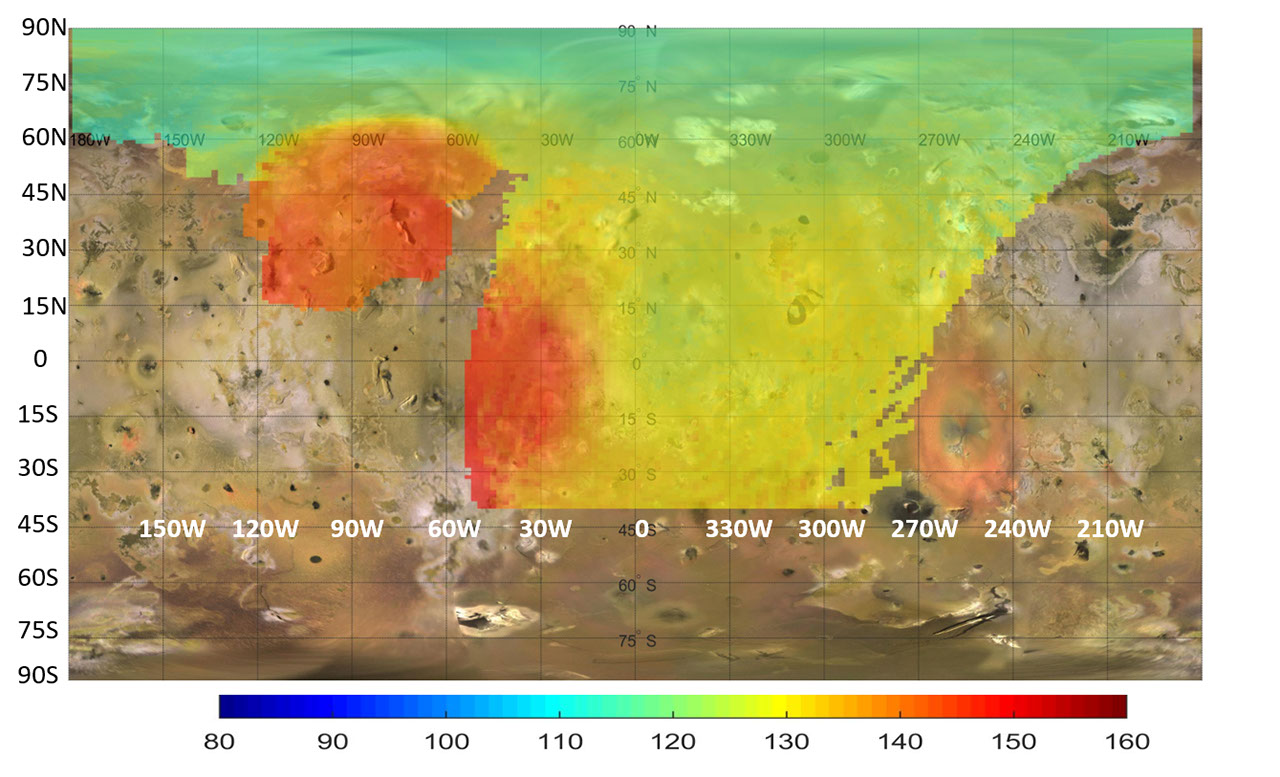
NASA’s Juno spacecraft has used its Microwave Radiometer (MWR) to map heat rising from just beneath the surface of Jupiter's moon Io. This data provides insights into the volcanic activity and internal heating mechanisms of the most volcanically active world in our solar system.
The MWR aboard Juno captured the data, revealing thermal emissions originating close to Io’s surface. Unlike infrared instruments which measure surface temperature, the MWR’s lowest frequency microwave channels (0.6 and 1.25 gigahertz) can penetrate approximately 6 to 12 miles beneath the surface.
The map created from this data indicates areas of rising heat. According to NASA, this capability allows scientists to study Io's internal processes in a new way. The agency explains that while infrared instruments measure the temperature *of* the moon’s surface, the MWR detects thermal energy emanating from *beneath* it.
The purpose of these observations is to better understand how Io generates such extreme volcanic activity despite its distance from Jupiter's primary heat source. This research will help scientists determine what drives the intense volcanism on Io and potentially provide insights into the internal heating processes of other rocky worlds.
We don't rate truth. We strip the spin and show you which perspectives covered the story. You decide.
Read the original coverage
💬 Comments
📜 Comment Policy