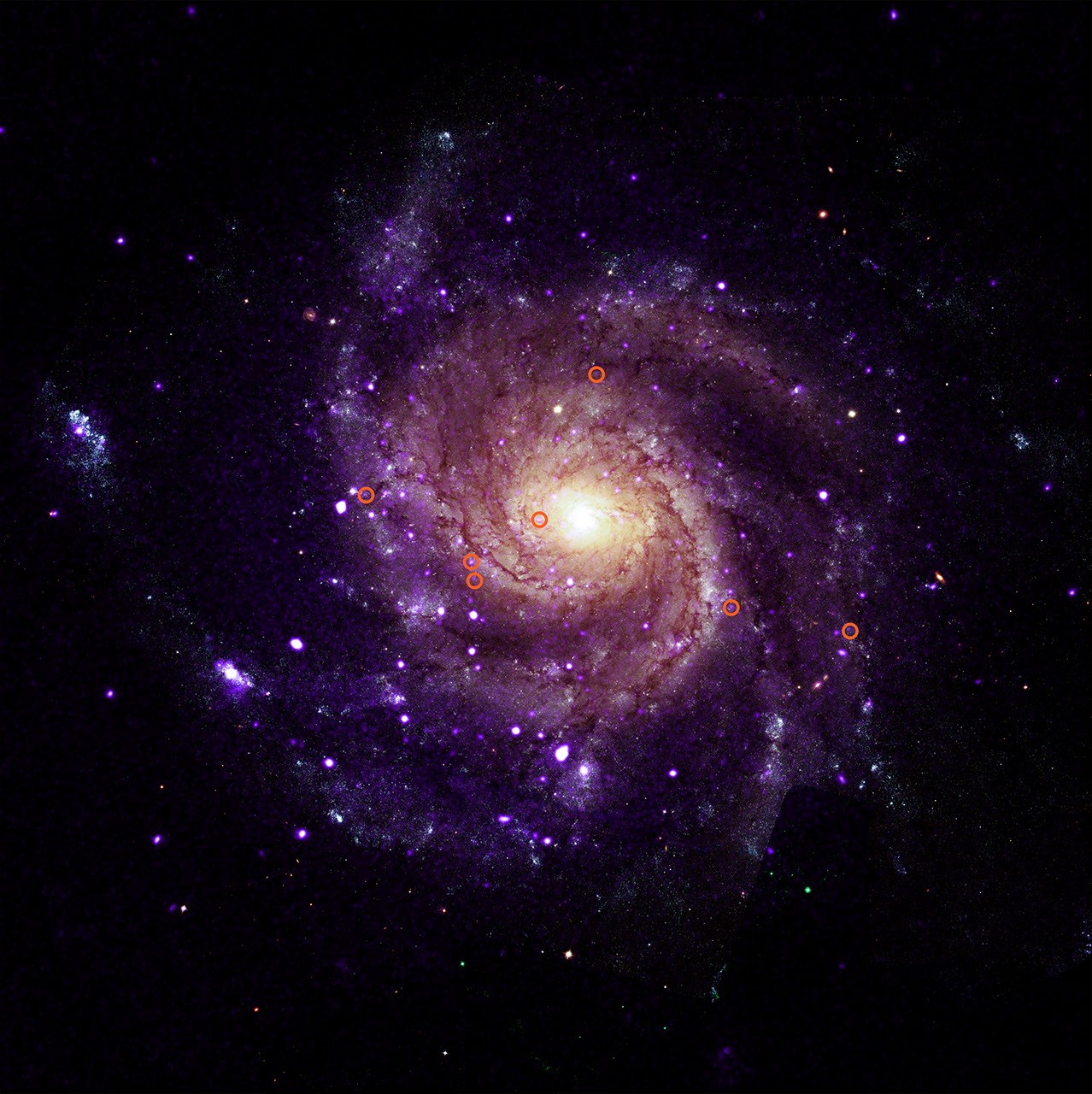
Using NASA’s Chandra X-ray Observatory, a team led by Mustafa Muhibullah of the University of Alabama has discovered 84 “hypersoft X-ray sources” in six galaxies. These objects emit unusually low-energy X-rays alongside intense ultraviolet radiation, a combination never before observed. The discovery could help solve two long-standing astrophysical questions related to the expansion of the universe and the origins of Type Ia supernovae.
The researchers identified the hypersoft X-ray sources by searching for objects visible in Chandra images at low X-ray energies that disappeared in higher-energy images. This indicates a disproportionately high emission of low-energy X-rays, which are closely linked to energetic ultraviolet radiation. The galaxies searched included the spirals M31 (Andromeda) and M101 (Pinwheel), as well as four elliptical galaxies. Sources were found in both regions of active star formation and areas with older stars.
Scientists believe these sources likely involve a black hole, neutron star, or white dwarf pulling material from a companion star. This process heats the material, producing X-rays before it falls onto the central object. While similar binary systems are known, they haven’t exhibited the same level of ultraviolet brightness and low-energy X-ray emission. “We’ve never encountered a group of objects that act like this,” said Mustafa Muhibullah. “Of course, the next step was to try to figure out what these things are.”
The discovery may provide insight into Type Ia supernovae, which play a crucial role in measuring the universe’s expansion. These supernovae originate from white dwarf systems that accrete material from companion stars. Identifying these systems before they explode could significantly advance astronomical understanding. “If we could find a way to spot these Type Ia supernova explosions before they go off, that would be really important,” said co-author Jimmy Irwin of the University of Alabama. Muhibullah added, “These clandestine X-ray sources are actually among the most energetic objects in galaxies, and they could be solving two cosmic mysteries at once.”
Read the original coverage
💬 Comments
📜 Comment Policy