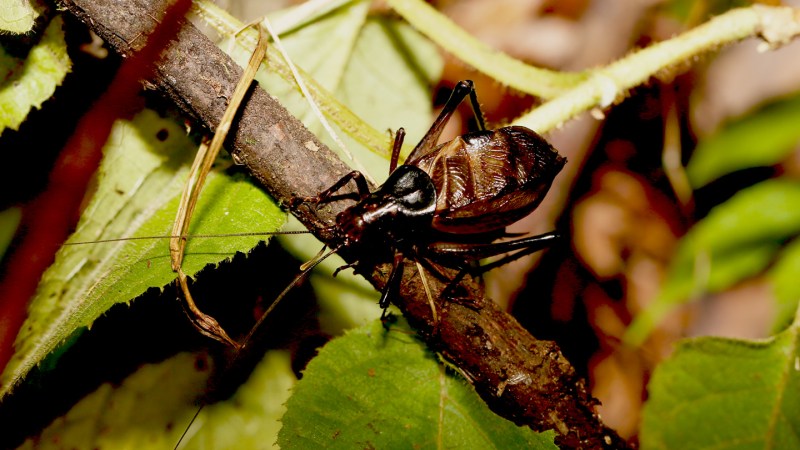
Fossils from China reveal the soundscape of the Jurassic period, allowing scientists to recreate the songs of ancient katydid relatives. The research, led by Jun-Jie Gu, demonstrates that these insects communicated through wing vibrations, producing distinct mating calls.
The remains of these ancient insects were discovered in the Daohugou region of rural China, a landscape characterized by hot, humid forests, giant ferns, and ancient conifers during the Jurassic Period, 200 million to 145 million years ago. The fossils belong to ensiferans, the group encompassing katydids, crickets, and grigs. Researchers analyzed the wing structures to understand how these insects produced sound.
According to biophysicist Fernando Montealegre-Zapata of the University of Lincoln in England, the wings function like “nature’s violin.” One wing features microscopic teeth, and a scraper on the opposing wing strikes these teeth during wing closure, generating vibrations amplified by the wing itself. This process creates a “syllable,” the fundamental unit of sound. By simulating wing acoustics for 20 fossils representing nine extinct species – considering teeth spacing, wing size, and vibrating area – the team reconstructed the insects’ calls.
To validate their methodology, the researchers reproduced the calls of modern katydids, crickets, and grigs using photos of their wings, confirming that the necessary measurements for sound determination can be obtained from 2-D wing images. The cadence of these syllables remains uncertain, so the team utilized a machine learning model trained on data from living ensiferans, relating body shape, size, and temperature to call patterns. Applying the temperature of the Jurassic rainforest, they simulated the ancient insect chorus.
Roy Plotnick, a paleobiologist at the University of Illinois Chicago who was not involved in the study, described the work as “very exciting,” noting the team’s ability to demonstrate that each species possessed a unique sound, potentially used for mate recognition. Scans of the insects’ ears, located on their forelegs, further support the idea that they were capable of hearing these sounds.
Read the original coverage
💬 Comments
📜 Comment Policy