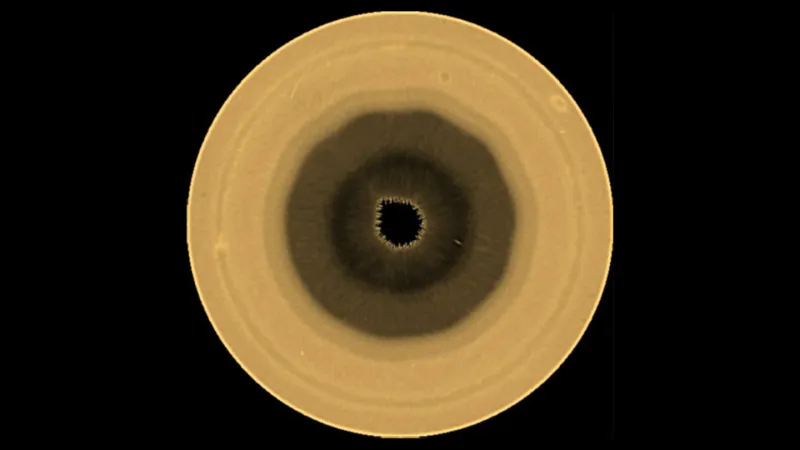
New images from the Hubble Space Telescope reveal a ten-sided jet stream at Saturn’s south pole, a feature not observed during the Cassini mission. Planetary scientists are intrigued by the discovery, suggesting the north pole’s hexagon may not be as unique as previously believed.
Scientists using the Hubble Space Telescope, along with a network of amateur astronomers, identified the unusual jet moving independently of Saturn’s other atmospheric patterns. Researchers report the findings in *Science Advances* on September 2. Agustín Sánchez-Lavega, a planetary scientist at the University of the Basque Country in Bilbao, Spain, says, “This discovery suggests that the hexagon [at the north pole] is not as extraordinary as previously thought.”
The decagon first appeared in Hubble images from last autumn, with earlier observations from 2023 confirming its presence, though less defined. The south pole was obscured from Earth’s view from 2012 until 2023, and no spacecraft have been stationed at Saturn since 2017, making it impossible to determine when the decagon first formed. Amy Simon, a planetary scientist at NASA’s Goddard Space Flight Center in Greenbelt, Md., notes the decagon appears to be more changeable than the hexagonal jet at the north pole, making its longevity uncertain.
MIT planetary scientist Wanying Kang, who was not involved in the research, explains that jet streams are normal on Saturn due to its size and rapid rotation—a day on Saturn lasts approximately 10.7 hours. This causes gas currents to form bands around the planet. However, the decagon’s angular shape is noteworthy and may provide insights into Saturn’s deeper atmosphere. The researchers have not yet fully explained the feature, but suggest it warrants further investigation.
Read the original coverage
💬 Comments
📜 Comment Policy