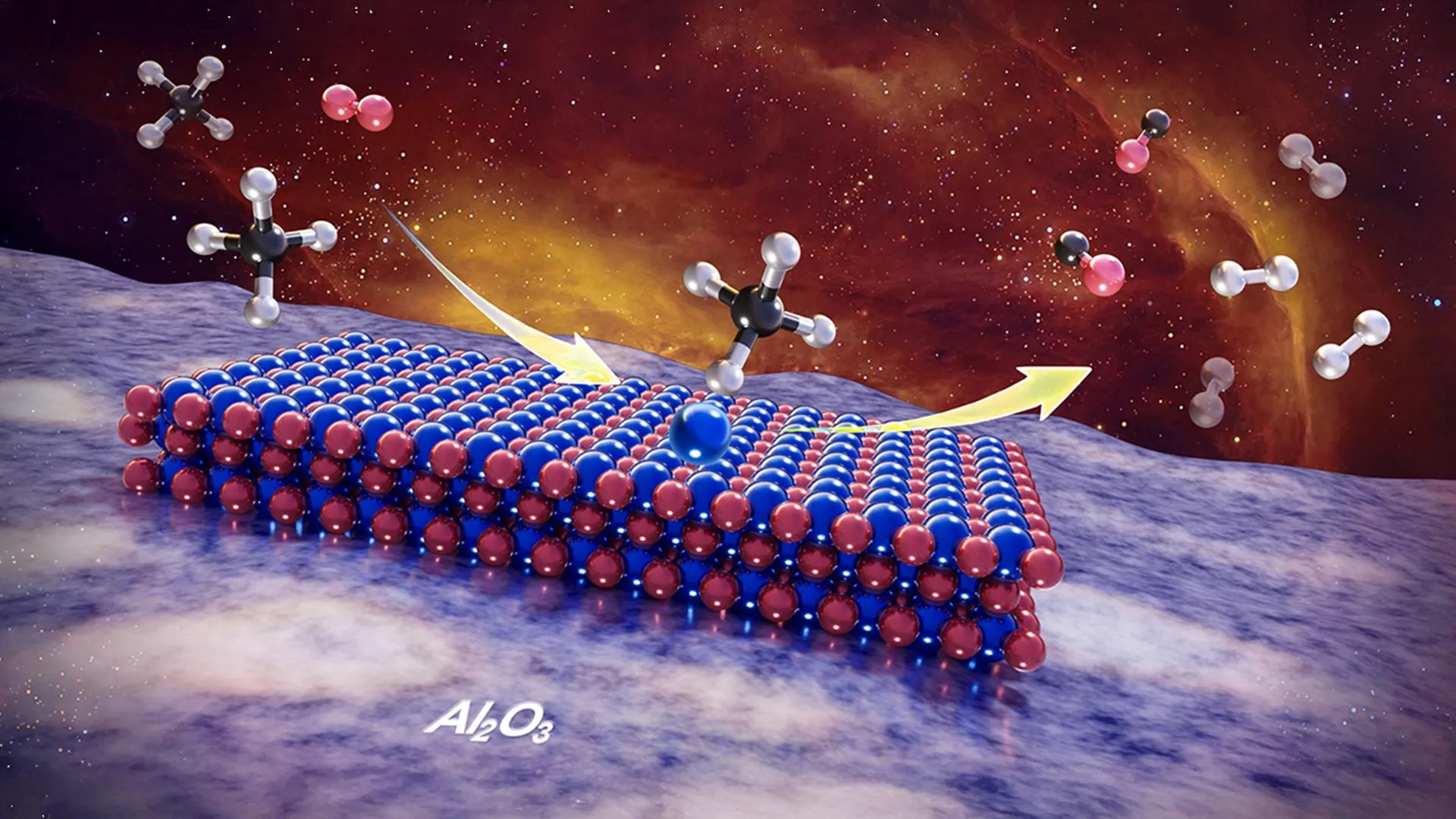
Chinese scientists at the Dalian Institute of Chemical Physics (DICP) have discovered a previously unknown atomic structure on nickel oxide that significantly enhances methane conversion. This finding explains why nickel oxide, rather than metallic nickel, is the primary driver of the reaction and allows for the creation of catalysts with drastically reduced nickel content.
The research, led by Professors Tao Zhang, Aiqin Wang, and Xiaoyan Liu of DICP, along with Professors Wei Liu (DICP), Tao Yang (Xi'an Jiaotong University), and Graham J. Hutchings (Cardiff University), focused on partial oxidation of methane (POM), a process used to create syngas for fuels and chemicals. For years, metallic nickel (Ni) nanoparticles were believed to be the key active centers in POM. However, the team questioned whether the metallic Ni observed after the reaction was actually responsible for the catalysis, or simply a byproduct of the process.
The scientists created a Ni/Al2O3 catalyst containing only 0.8 wt% Ni using a microemulsion method. This low-nickel catalyst demonstrated a high level of performance, converting 92% of the methane with 87.0% selectivity for CO and H2, maintaining a stable H2/CO molar ratio of 2.0. Remarkably, after the reaction, almost no metallic Ni was detectable in the catalyst.
Despite the minimal nickel content, the catalyst’s performance rivaled that of a catalyst containing ten times more nickel (8.0 wt% Ni/Al2O3 produced through impregnation). The low-loading catalyst also outperformed a similarly low-nickel catalyst prepared using the impregnation method, which only exhibited methane combustion instead of effective POM. The discovery reveals the atomic-scale source of the catalytic activity and highlights the importance of observing catalysts under realistic operating conditions.
Read the original coverage
💬 Comments
📜 Comment Policy