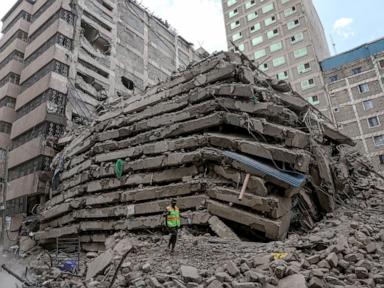
A multi-story building under construction collapsed Friday in Nairobi’s Eastleigh area, trapping an unknown number of people and prompting a rescue effort complicated by looting and a lack of heavy equipment. The building, reportedly between 12 and 18 stories tall, collapsed around 1 p.m. local time, reducing it to a pile of rubble. While rescue teams worked to access those trapped, police used tear gas to disperse looters targeting neighboring shops. Residents reported receiving calls for help from those inside immediately after the collapse, but contact was later lost.
Nairobi police chief Issa Mohamud said the building had more than 10 floors under construction, with the ground and basement levels occupied by businesses. Governor Johnson Sakaja’s office confirmed people may be trapped and stated the building lacked an occupation certificate, suggesting it was not legally authorized for occupancy. Witnesses reported seeing cracks in the structure before the collapse, and Bibiye Mahmoud, president of the Institution of Engineering Technology of Kenya, attributed the incident to a lack of professional oversight during construction.
Building collapses are a recurring problem in Nairobi, with a report by the Kenya Institute for Public Policy Research and Analysis documenting 86 collapses between 2009 and 2019, resulting in an estimated 200 deaths. A National Building Inspectorate audit found that almost 87% of buildings nationwide failed to meet safety standards or lacked necessary approvals. The number of buildings completed annually in Nairobi has increased from 20,025 in 2022 to 25,090 last year, driven by rapid population growth and economic expansion. The cause of this particular collapse remains unclear, but concerns over lax enforcement of building codes and corruption are being raised.
Our reading is that this collapse, while tragic, is not an isolated incident but part of a pattern of unsafe construction practices in Nairobi. The lack of an occupation certificate and reported pre-collapse cracks suggest a disregard for safety protocols, and the looting complicates an already difficult rescue operation, highlighting broader societal issues. The attribution of the incident to a lack of professional oversight reinforces the idea that systemic problems, rather than a single cause, are at play.
Read the original coverage
💬 Comments
📜 Comment Policy