Xi Greets Trump in China Ahead of Trilateral Talks with Putin
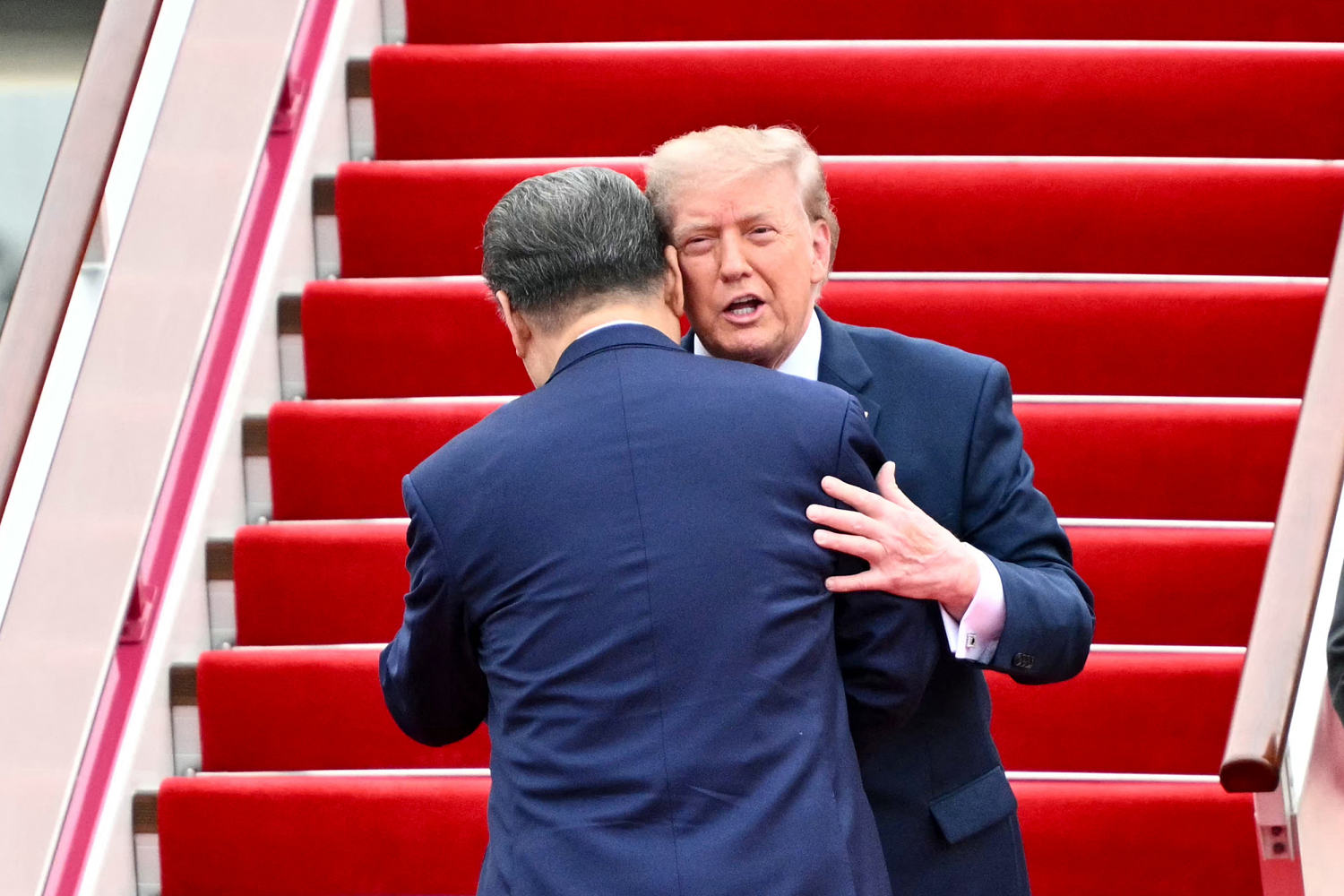
Chinese President Xi Jinping personally greeted President Donald Trump upon his arrival in Shenzhen, China, a rare gesture not extended to Russian President Vladimir Putin, who arrived earlier and was met by a close Xi advisor. The greeting reciprocates Trump’s welcome of Xi at the White House in September. The leaders are set to hold an unprecedented trilateral meeting Thursday alongside the APEC summit, with discussions expected to center on Ukraine, Iran, and artificial intelligence. While expectations for a concrete agreement are low, the meeting is seen as a potential entry point for dialogue. Putin, who met with Xi earlier Wednesday, indicated Russia and China discussed the war in Ukraine and expanding cooperation in trade, energy, and education. Trump also met with Philippine President Ferdinand Marcos Jr., announcing a “very big” trade deal, and with leaders of the Quad nations, pledging $85 million for AI software. North Korean leader Kim Jong-Un may also attend the summit. Analysts suggest Xi’s personal greeting for Trump is a display of courtesy intended to maintain a positive rapport ahead of potentially turbulent U.S.-China relations, acknowledging Trump’s preference for such gestures.
Where they differ
- CBS News detailed Trump’s meeting with Philippine President Marcos Jr. and the announcement of a new trade deal, a detail less prominent in NBC and CNBC’s coverage.
- CNBC emphasized Xi’s opening remarks at the APEC summit, focusing on free trade and AI cooperation, while other outlets focused more on the upcoming trilateral meeting.
- NBC News highlighted analysis from the International Crisis Group regarding Xi’s motivations for greeting Trump, a perspective not explicitly present in the CBS or CNBC reports.
What is not yet known
- The specific details of the “very big” trade deal between the U.S. and the Philippines remain unspecified.
- The extent to which the trilateral meeting will address concerns from Ukraine, Taiwan, and Iran is unclear.
Background
- Donald Trump is undertaking a trip to Asia, including meetings with leaders from China and Russia, as part of the APEC summit [Fact Refinery, 2026-11-18].
- The APEC club represents over 50% of global GDP and includes 21 members, such as China, Russia, and the US [Fact Refinery, 2026-11-18].
- Prior to this summit, the US experienced a nationwide FAA ground stop, prompting Trump to blame “old equipment” [Fact Refinery, 2026-11-18].
- Russia and China discussed the war in Ukraine and expanding cooperation in trade, energy, and education prior to the trilateral meeting [Frognews].
- Ukraine is currently experiencing disruptions to its Starlink service, impacting its defense capabilities [Fact Refinery, 2026-11-12].
Our reading
We begin by assessing the most likely outcome: a continuation of dialogue without immediate, substantial agreements. Xi’s gesture towards Trump suggests a desire to stabilize relations, and the trilateral meeting itself signals a willingness to engage, even given existing tensions. A breakthrough on Ukraine seems less likely, given Russia’s stated positions and Ukraine’s reliance on disrupted satellite connectivity. However, a commitment to further talks, perhaps mediated by Kushner and Witkoff, is plausible. Should Putin and Xi demonstrate a unified front on Ukraine, or Trump insist on conditions unacceptable to either of them, the meeting could yield no tangible results. The inclusion of artificial intelligence as a key discussion point is noteworthy. Xi’s emphasis on AI cooperation, as reported by CNBC and reinforced in the prior article, suggests China seeks to position itself as a leader in this field, potentially contrasting its approach with US export controls. The $85 million pledge for AI software, alongside the trade deal with the Philippines, indicates the US is also prioritizing technological development and regional partnerships. This competition over AI could become a defining feature of US-China relations. The situation in Ukraine appears to be a sticking point. Russia’s opposition to European involvement in negotiations, coupled with the ongoing Starlink disruptions, suggests a desire to control the narrative and limit Ukraine’s capabilities. The US envoys’ meetings with Putin and Zelensky indicate an attempt to bridge the gap, but the lack of clarity regarding the cause of the Starlink issues raises questions about external interference and potential escalation.
What to watch
- The content of the joint statement from the APEC summit, specifically regarding Ukraine, Iran, and AI cooperation [APEC official, Reuters].
- Details of the “very big” trade deal between the US and the Philippines, including specific sectors and commitments [CBS News].
- Any statements from Nvidia regarding Jensen Huang’s potential reinstatement as CEO, and any impact on US tech policy [Fact Refinery, 2026-11-18].
Read the original coverage
💬 Comments
📜 Comment Policy