Trump Highlights Relationship with Xi After Asia Trip, Disputes Midterm Results
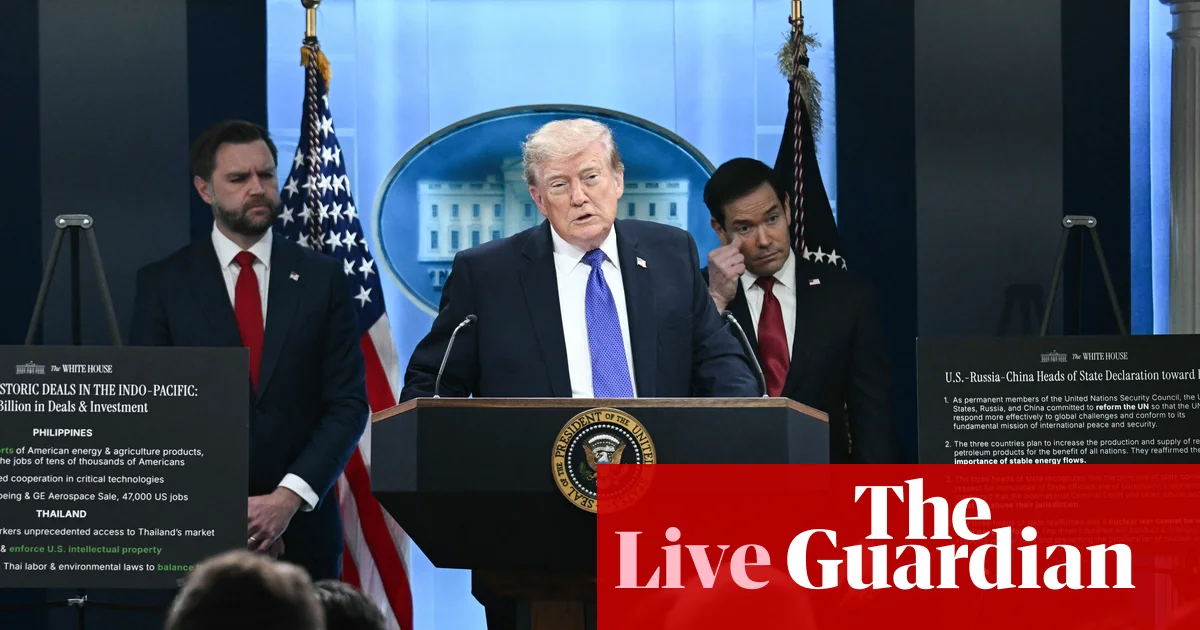
Donald Trump, following a trip to Asia that included a trilateral meeting with Chinese President Xi Jinping and Russian President Vladimir Putin, emphasized his “great relationship” with Xi during a White House press conference. Trump repeatedly claimed the Republican midterm losses were due to his absence from the ballot, asserting voters felt he was “not treated well” by his party. He also stated he would have added to JD Vance’s assessment blaming the Iran war for Republican losses, affirming he would support continued pressure on Iran to prevent nuclear weapons development. Trump reiterated his unsubstantiated claim that the 2020 election was stolen, linking it to the ongoing war in Ukraine and suggesting a resolution could be reached with the involvement of both Zelenskyy and Putin. Vice President Vance, speaking after Trump, likened his duties while Trump was abroad to the movie *Home Alone*, but with “better food and more gold.”
Trump described his meeting with Putin as productive, noting the Russian leader “clearly expressed his desire” to end the war in Ukraine diplomatically. He also defended his relationship with Xi, framing it as positive despite ongoing geopolitical tensions. The president claimed the country has seen wealth increase under his leadership, despite current inflation rates exceeding those when he took office. He also stated he considered JD Vance’s statement blaming the Republican midterm wipeout on the Iran war to be “fine.”
Left-leaning outlets focused on Trump’s continued promotion of election falsehoods and his downplaying of the Republican midterm losses, while highlighting the contrast between his claims and the ongoing conflict in Ukraine. No right-leaning outlet reported this story.
Background
- Donald Trump met with Vladimir Putin in China, stating the meeting was a ‘12’ on a scale of 1 to 10 [Fact Refinery, 2026-11-20].
- During a trilateral summit in Shenzhen, China, an agreement was reached regarding human oversight of military applications of AI, though few concrete deliverables on major global issues were achieved [Fact Refinery, 2026-11-20].
- Following the 2024 election, JD Vance is serving as Vice President [Frognews].
- The Justice Department dropped a lawsuit seeking to block Alaska’s U.S. Senate race certification, acknowledging Democrat Mary Peltola’s win after allegations of voter confusion [Fact Refinery, 2026-11-20].
Our reading
We begin by assessing the most likely outcome: a continuation of the status quo. Trump appears intent on maintaining relationships with both Xi and Putin, regardless of geopolitical tensions or ongoing conflicts. His emphasis on personal connections, coupled with his dismissal of midterm losses as stemming from internal Republican issues, suggests he will prioritize these relationships over addressing concerns about China’s AI advancements or Russia’s war in Ukraine. A less likely scenario involves a significant shift in U.S. policy towards either country, triggered by a demonstrable breach of trust or a major escalation of conflict. This would require substantial pressure from within his own administration or a dramatic change in public opinion. The continued focus on the 2020 election, linked to the Ukraine war, is a broader aspect worth noting. This narrative serves to undermine support for Ukraine and potentially justify a negotiated settlement on terms favorable to Russia. Trump’s framing of the situation suggests a desire to disengage from the conflict, potentially leaving European allies to bear the brunt of the consequences. Regarding the other side, Putin likely views Trump’s continued overtures as a validation of his strategy and a potential weakening of Western resolve. While Trump presents the meeting as productive, Putin’s primary interest is likely to secure a degree of international legitimacy and create divisions within the transatlantic alliance. The joint declaration on “peace” appears designed to project an image of Russia as a responsible actor, despite its ongoing aggression in Ukraine.
What to watch
- The next public statements from Xi Jinping or Putin regarding their meetings with Trump [Official government websites].
- Any changes in U.S. export controls on AI chips to China [Commerce Department website].
- The outcome of negotiations regarding EU student tuition fees in the UK [UK government and EU Commission websites].
Read the original coverage
💬 Comments
📜 Comment Policy