Russian Ship at Libyan Port Damaged in Suspected Drone Attack
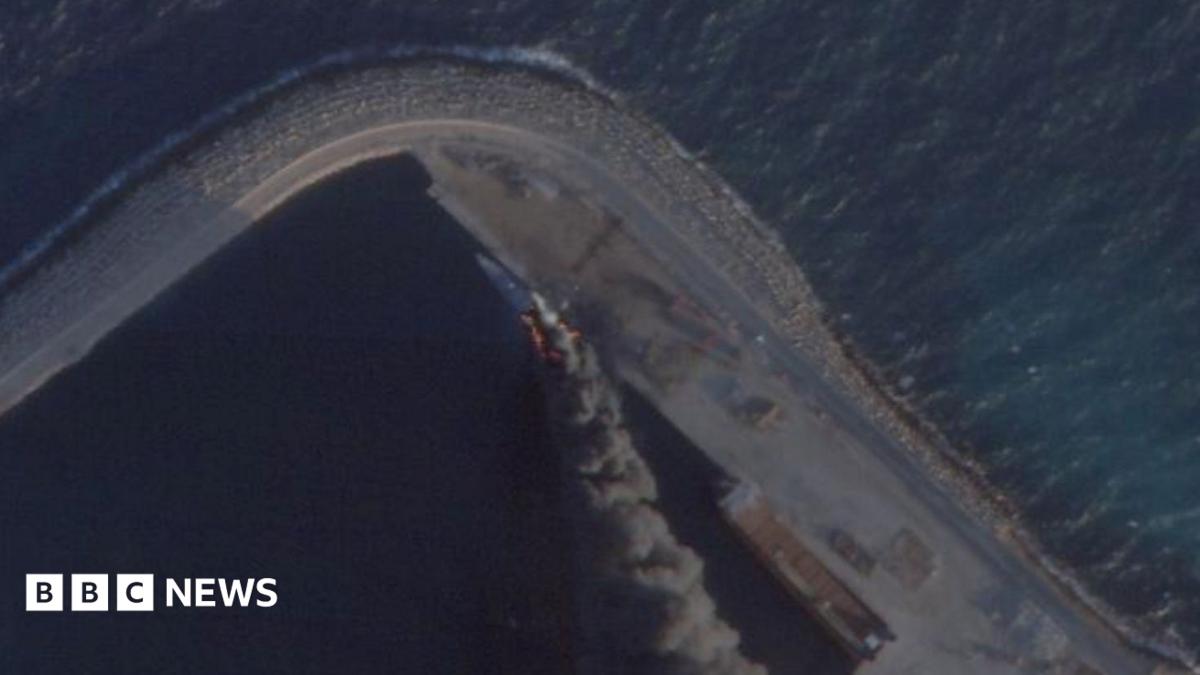
An explosion occurred early Sunday on a Russian ship docked at the Benghazi naval base in Libya, likely caused by an attack using unmanned vehicles. Eastern Libyan authorities are investigating the incident, coordinating with their Russian counterparts to determine the source of the suspected drone attack and those responsible. Satellite imagery from Planet Labs PBC shows the ship on fire and partially submerged at 0547 GMT. The vessel had stopped for fuel and supplies while en route back to Russia, Libyan state media reported. No casualties were reported, and the site has been secured. The eastern-based Government of National Stability (GNS) stated the ship was using the port under an existing maritime agreement. Separately, Libya’s internationally recognized government in Tripoli, the Government of National Unity (GNU), warned against hosting foreign forces and allowing them to use Libyan facilities, citing risks associated with involving ports in external conflicts.
The incident occurs amidst a fractured political landscape in Libya, following the overthrow of Muammar Gaddafi in 2011, which led to the emergence of opposing governments. The GNS and GNU represent these competing authorities. The GNU’s statement did not directly address the attack on the Russian vessel but cautioned against the use of Libyan ports by foreign forces, raising concerns about potential threats to citizens and national assets. The GNS has stated Libya is not a party to the Russia-Ukraine war or any other external conflicts.
Where they differ
- BBC Verify reviewed satellite imagery and geolocated social media videos to confirm the ship was on fire and partially submerged, providing visual evidence not present in the Bloomberg report.
- The BBC included the statement from Libya’s internationally recognized government in Tripoli (GNU), warning against hosting foreign forces, while Bloomberg did not.
- Bloomberg focused solely on the eastern Libyan authorities’ assessment of the attack, while the BBC also included the context of Libya’s fractured political landscape and the existence of a competing government in Tripoli.
What is not yet known
- The identity of the party responsible for the attack remains under investigation.
- The extent of the damage to the ship and its impact on its return to Russia is currently unknown.
Background
- Libya experienced a political upheaval following the overthrow of Muammar Gaddafi in 2011, resulting in competing governments [Fact Refinery, 2026-11-22]. Currently, the Government of National Stability (GNS) and the Government of National Unity (GNU) represent these rival authorities [Fact Refinery, 2026-11-22]. There is an existing maritime agreement allowing Russian vessels to use the Benghazi naval base [Fact Refinery, 2026-11-22]. In April 2026, a damaged Russian LNG tanker broke loose from a tow off the Libyan coast [Fact Refinery, 2026-04-02]. [background knowledge] Libya possesses significant oil reserves and is strategically located in North Africa.
Our reading
We begin by assessing the most likely outcome: further investigation will reveal the source of the drone attack, potentially escalating tensions between Russia and the responsible party, though direct military retaliation within Libya seems less likely given the GNS’s stated neutrality. A less likely scenario involves a broader confrontation if Russia attributes the attack to a state actor and demands action, potentially drawing other nations into the conflict. The key to determining the path forward will be whether the investigation identifies a state sponsor or a non-state actor. The incident highlights the vulnerability of Libyan ports and infrastructure due to the ongoing political division. The GNU’s warning against foreign forces using Libyan facilities suggests a concern that the GNS may be aligning too closely with Russia, potentially turning Libya into a proxy battleground. This division could further destabilize the region and complicate efforts to establish a unified government. Considering the GNS’s claim of non-involvement in external conflicts, it is worth noting that maintaining this stance may become increasingly difficult if evidence emerges linking the attack to a party hostile to Russia. The GNS may face internal pressure to respond, even if it risks escalating the situation.
What to watch
- Official findings of the joint Libyan-Russian investigation into the source of the drone attack [GNS/Russian State Media].
- Any statements from Russia regarding responsibility for the attack and potential responses [Russian State Media].
- Developments in the relationship between the GNS and GNU, specifically regarding port security and foreign military presence [Libyan State Media, BBC Verify].
Read the original coverage
💬 Comments
📜 Comment Policy