Nasa Crash Test Creates Stadium-Sized Crater on Asteroid Dimorphos
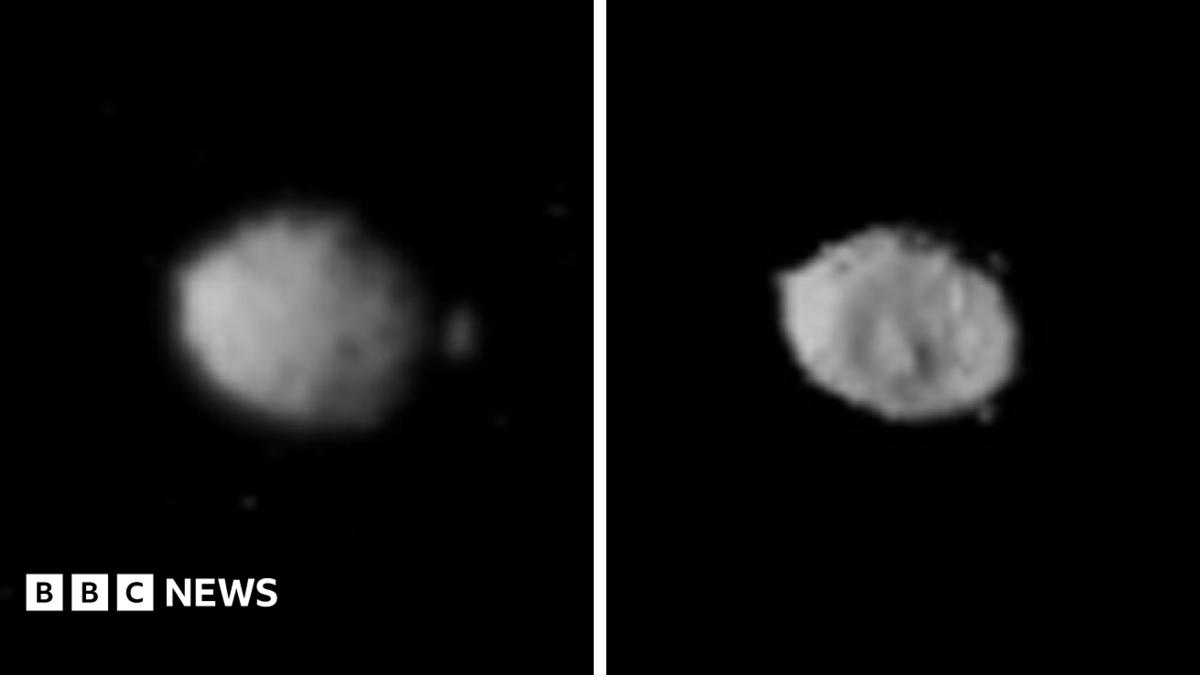
Images released this week reveal a crater roughly the size of a stadium on the asteroid Dimorphos, the result of a 2022 Nasa mission designed to test planetary defense capabilities. The DART spacecraft intentionally collided with the 150-meter-wide asteroid at 14,000 mph, successfully altering its orbit around the larger asteroid Didymos, shortening its orbital period by approximately 33 minutes from 11 hours and 55 minutes. The European Space Agency’s Hera mission is now assessing the damage and gathering data to refine models of asteroid deflection. Scientists describe the impact as ‘spectacular’ and ‘chaotic,’ noting that Dimorphos is now tumbling irregularly, unlike its previous stable orbit. The 6,200-mile debris trail from the impact was visible from Earth and space telescopes.
The collision was not a response to an immediate threat, but a test of humanity’s ability to deflect a potentially hazardous asteroid. Hera’s primary objective is to measure Dimorphos’s mass to determine the effectiveness of the impact and inform future deflection strategies. Scientists emphasize the importance of this research, citing the asteroid impact 66 million years ago that altered life on Earth. The gravity on Didymos, which Dimorphos orbits, is approximately 40,000 times weaker than Earth’s. Hundreds of previously unknown boulders surround the asteroid pair. The impact flattened the face of Dimorphos, creating the large crater, and simultaneously altered its shape and movement. Before the impact, Dimorphos consistently presented the same face to Didymos, similar to Earth’s moon; now it tumbles chaotically.
Where they differ
- The Independent and Sky News both highlighted the comparison of the crater's size to a stadium, while the BBC did not emphasize this visual comparison as prominently.
- The Independent included a quote from Hera’s principal investigator, Patrick Michel, detailing the asteroid’s changed shape, which was not present in the other reports.
- Sky News led with the speed of the impact (14,000mph), while the BBC and Independent focused on the resulting crater.
What is not yet known
- The long-term effects of the impact on the asteroid system remain under investigation, as Hera’s mission is ongoing.
- The precise mass of Dimorphos, crucial for calculating deflection effectiveness, is still being measured by the Hera mission.
Read the original coverage
💬 Comments
📜 Comment Policy