Carney Affirms Canadian Self-Determination Following Musk’s Separatist Remarks
Politics
✓ Neutralized●○●
1h ago

Carney Affirms Canadian Self-Determination Following Musk’s Separatist Remarks

AI-synthesized · Bias removed · Facts only
2 sources: 1 left · 0 center · 1 right
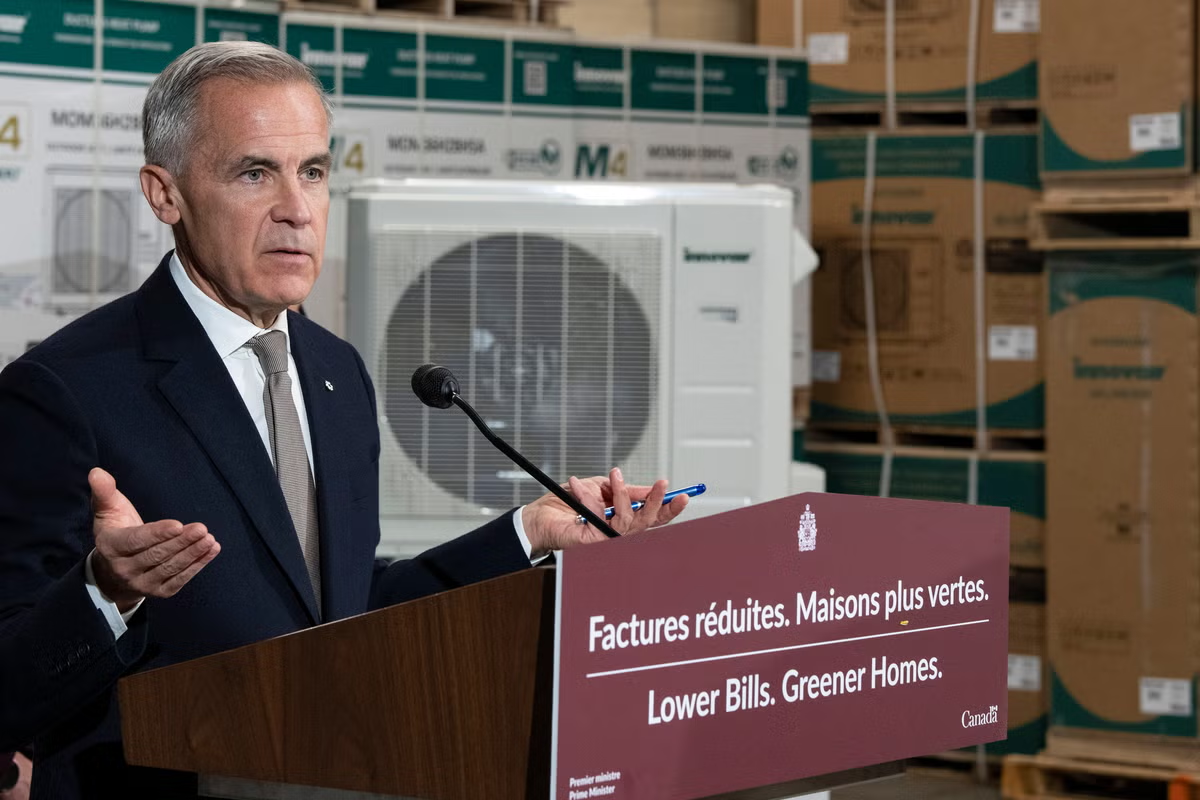
Image: Washington Times

Canadian Prime Minister Mark Carney stated Thursday that Canada’s future will be determined by Canadians, responding to Elon Musk’s call for Quebec, Alberta, and Saskatchewan to separate. Musk made the comments Wednesday on X, following the Quebec provincial election, where the separatist Parti Québécois won Monday but fell short of a majority. Carney also cautioned against interference “from foreign governments and large tech firms that think they can tell us what to do.”

While support for Quebec independence remains around 30%, according to McGill University political science professor Daniel Béland, the recent election was primarily driven by a desire to replace the incumbent government. Musk advocated for the separation of Quebec, Alberta, and Saskatchewan, stating they “would be better off.”

Alberta Premier Danielle Smith indicated that separatist sentiment in her province has lessened due to increased cooperation with the federal government and Carney’s office. Saskatchewan Premier Scott Moe responded to Musk’s post on X with a simple “No.” Carney emphasized that Canadians should be able to live according to their languages and cultures without external influence. Alberta is scheduled to hold a vote on October 19 regarding remaining in Canada or pursuing a future referendum on separation, though Smith has stated she will vote to remain.

Where they differ

  • The Independent highlighted Carney’s broader warning against interference from large tech firms, framing Musk’s comments as an example of overreach.
  • The Washington Times focused more directly on Carney’s pushback against Musk’s separatist call, presenting it as a defense of Canadian unity.

What is not yet known

  • The long-term impact of the Parti Québécois’s victory on the Quebec separatist movement remains to be seen.
  • Whether Alberta’s vote on October 19 will significantly shift the province’s stance on separation is currently uncertain.

Background

  • Mark Carney is the current Prime Minister of Canada [background knowledge].
  • In late September 2026, Canada and the EU were discussing a new “associate membership” for Canada, aiming to deepen cooperation in multiple sectors, amidst strained relations with the United States [Fact Refinery, 2026-09-17].
  • The United States imposed import bans on certain Canadian goods in late September 2026, escalating a trade dispute triggered by Canadian tariffs [Fact Refinery, 2026-09-29].
  • The Parti Québécois won the Quebec provincial election on Monday, but did not secure a majority government [Fact Refinery, 2026-09-29].

Our reading

Our reading is that Carney is asserting Canadian sovereignty in the face of both internal separatist pressures and external interference, particularly from the US and, now, Elon Musk. The framing of Musk’s comments as “interference” alongside that of “foreign governments” suggests a deliberate effort to link the two, and to position Canada as resisting external attempts to dictate its future. The emphasis on Canadians determining their own future, coupled with the acknowledgement of cultural and linguistic rights, appears to be a direct appeal to national unity.

What to watch

  • The results of Alberta’s vote on October 19 regarding potential separation, and whether Smith follows through on her stated intention to vote to remain [article text].
  • Whether the US responds to the Canada-EU alliance with further trade restrictions or public statements, potentially escalating tensions [Fact Refinery, 2026-09-17].
  • The long-term impact of the Parti Québécois’s performance in the Quebec election on separatist sentiment, as measured by future polling data [article text].
Was this useful?

Read the original coverage

💬 Comments

📜 Comment Policy