Asteroid Dimorphos: Hera Probe Delivers Detailed Images After NASA Impact
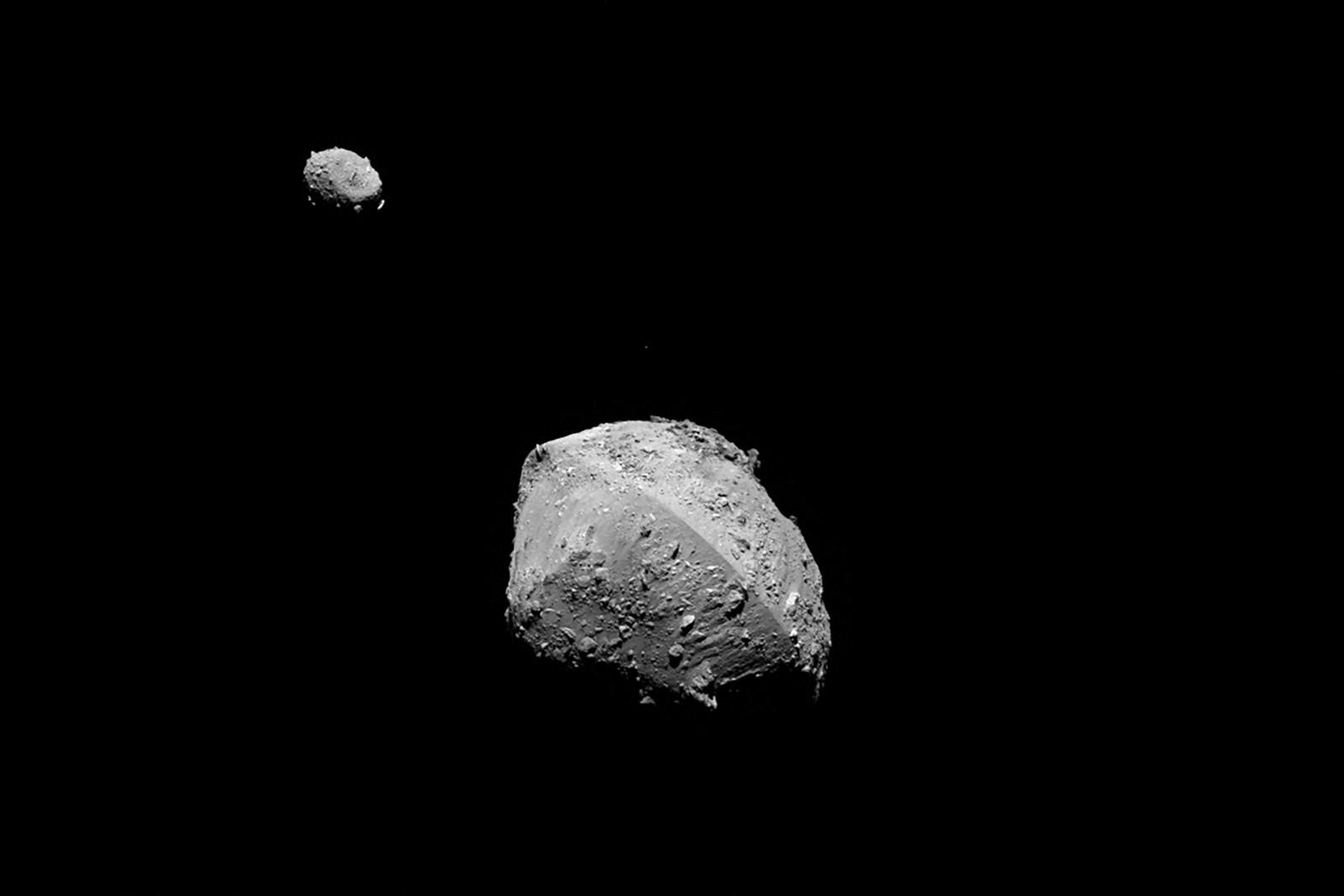
The European space probe Hera has beamed detailed close up images of the asteroid Dimorphos back to Earth, after the NASA probe Dart intentionally crashed into the celestial body in September 2022. The images show a crater the size of a football stadium and confirm that the impact caused the asteroid to tumble. The mission serves to research methods for defending against potentially dangerous asteroids by changing the trajectory of a celestial body through a targeted impact. The orbital period of Dimorphos around the larger asteroid Didymos was shortened by 33 minutes due to the impact, significantly more than the originally targeted 73 seconds. The ESA probe Hera is now intended to examine the asteroid more closely in the coming months, coming as close as three kilometers to obtain high resolution images. An unexpected challenge is the discovery of hundreds of rock fragments in the vicinity of the asteroid pair, which could complicate the planned landing of mini probes. Scientists from the University of Bern had simulated various scenarios before the impact and suspect that Dimorphos is not a compact boulder. The images confirm that the impact has strongly altered the object, with a "cigar shaped structure" discovered in the crater. Although Didymos and Dimorphos currently pose no danger to Earth, the mission is intended to help protect Earth from future asteroid impacts. According to the German Aerospace Center (DLR), the mission proves that humanity is no longer helplessly exposed to dangers from space.
Where they differ
- NZZ.ch and FAZ emphasized the difficulties in landing the mini probes due to the many rock fragments, while other sources only mentioned this in passing.
- Deutschlandfunk (DLF) highlighted the importance of the mission for asteroid defense and quoted Anke Pagels Kerp from the DLR, who described the images as more than a scientific sensation.
- Spiegel.de and Tagesanzeiger.ch focused on the detailed images and the discovery of the crater, while NTV.de compared the size of the crater to that of a football stadium.
- NZZ.ch mentioned that the ESA might be withholding the best images, which is not mentioned in other sources.
What is not yet known
- The exact mass of the asteroid Dimorphos remains unknown, which complicates the calculation of the deflection efficiency.
- It is still unclear whether the mini probes can actually land on Dimorphos, given the many rock fragments in the vicinity of the asteroid.
Read the original coverage
💬 Comments
📜 Comment Policy